

The SAP C_ABAPD_2309 Questions & Practice Test are Available On-Demand
Valid C_ABAPD_2309 Exam Dumps Ensure you a HIGH SCORE
SAP C_ABAPD_2309 Exam Syllabus Topics:
| Topic | Details |
|---|---|
| Topic 1 |
|
| Topic 2 |
|
| Topic 3 |
|
NEW QUESTION # 19
Which of the following integration frameworks have been released for ABAP cloud development? Note:
There are 3 correct answers to this question.
- A. Business Events
- B. OData services
- C. CDS Views
- D. Business Add-ins (BAdls)
- E. SOAP consumption
Answer: A,B,E
Explanation:
The following are the integration frameworks that have been released for ABAP cloud development:
* SOAP consumption: This framework allows you to consume SOAP web services from ABAP cloud applications. You can use the ABAP Development Tools in Eclipse to create a service consumption model based on a WSDL file or URL. The service consumption model generates the required ABAP artifacts, such as proxy classes, data types, and constants, to access the web service. You can then use the proxy classes to call the web service operations from your ABAP code1
* Business Events: This framework allows you to publish and subscribe to business events from ABAP cloud applications. Business events are messages that represent a change in the state of a business object or process. You can use the ABAP Development Tools in Eclipse to create a business event definition based on a CDS view entity or a projection view. The business event definition specifies the event key, the event payload, and the event metadata. You can then use the ABAP Messaging Channel (AMC) framework to publish and subscribe to business events using the AMC API2
* OData services: This framework allows you to expose and consume OData services from ABAP cloud applications. OData is a standardized protocol for creating and consuming RESTful APIs. You can use the ABAP RESTful Application Programming Model (RAP) to create OData services based on CDS view entities or projection views. The RAP framework generates the required OData metadata and runtime artifacts, such as service definitions, service bindings, and service implementations. You can then use the SAP Gateway framework to register and activate your OData services. You can also use the ABAP Development Tools in Eclipse to consume OData services from other sources using the service consumption model3 The other integration frameworks are not released for ABAP cloud development, as they are either not supported or not recommended for cloud scenarios. These frameworks are:
* CDS Views: CDS views are not an integration framework, but a data modeling framework. CDS views are used to define data models based on database tables or other CDS view entities. CDS views can have associations, aggregations, filters, parameters, and annotations. CDS views can also be used as the basis for other integration frameworks, such as OData services or business events4
* Business Add-ins (BAdls): BAdls are not supported for ABAP cloud development, as they are part of
* the classic ABAP enhancement framework. BAdls are used to implement custom logic in predefined enhancement spots in the standard SAP code. BAdls are not compatible with the cloud strategy and the clean core paradigm, as they modify the SAP code and can cause upgrade and maintenance issues. For ABAP cloud development, SAP recommends using the key user extensibility tools or the side-by-side extensibility approach instead of BAdls.
References: Consuming SOAP Services - ABAP Keyword Documentation, Business Events - ABAP Keyword Documentation, OData Services - ABAP Keyword Documentation, CDS Data Model Views - ABAP Keyword Documentation, [Business Add-Ins (BAdIs) - ABAP Keyword Documentation]
NEW QUESTION # 20
What are the effects of this annotation? Note: There are 2 correct answers to this question.
- A. The value of sy-langu will be passed to the CDS view automatically both when you use the -1 CDS view in ABAP and in another CDS view entity (view on view).
- B. You can still override the default value with a value of your own.
- C. It is no longer possible to pass your own value to the parameter.
- D. The value of sy-langu will be passed to the CDS view automatically when you use the CDS view in ABAP but not when you use it in another view entity
Answer: A,B
Explanation:
The annotation @Environment.systemField: #LANGUAGE is used to assign the ABAP system field sy-langu to an input parameter of a CDS view or a CDS table function. This enables the implicit parameter passing in Open SQL, which means that the value of sy-langu will be automatically passed to the CDS view without explicitly specifying it in the WHERE clause. This also applies to the CDS views that use the annotated CDS view as a data source, which means that the value of sy-langu will be propagated to the nested CDS views (view on view)12. For example:
* The following code snippet defines a CDS view ZI_FLIGHT_TEXTS with an input parameter p_langu that is annotated with @Environment.systemField: #LANGUAGE:
define view ZI_FLIGHT_TEXTS with parameters p_langu : syst_langu @<Environment.systemField:
#LANGUAGE as select from sflight left outer join scarr on sflight.carrid = scarr.carrid left outer join stext on scarr.carrid = stext.carrid { sflight.carrid, sflight.connid, sflight.fldate, scarr.carrname, stext.text as carrtext } where stext.langu = :p_langu
* The following code snippet shows how to use the CDS view ZI_FLIGHT_TEXTS in ABAP without specifying the value of p_langu in the WHERE clause. The value of sy-langu will be automatically passed to the CDS view:
SELECT carrid, connid, fldate, carrname, carrtext FROM zi_flight_texts INTO TABLE @DATA(lt_flights).
* The following code snippet shows how to use the CDS view ZI_FLIGHT_TEXTS in another CDS view ZI_FLIGHT_REPORT. The value of sy-langu will be automatically passed to the nested CDS view ZI_FLIGHT_TEXTS:
define view ZI_FLIGHT_REPORT with parameters p_langu : syst_langu @<Environment.systemField:
#LANGUAGE as select from zi_flight_texts(p_langu) { carrid, connid, fldate, carrname, carrtext, count(*) as flight_count } group by carrid, connid, fldate, carrname, carrtext The annotation @Environment.systemField: #LANGUAGE does not prevent the possibility of overriding the default value with a value of your own. You can still specify a different value for the input parameter p_langu in the WHERE clause, either in ABAP or in another CDS view. This will override the value of sy-langu and pass the specified value to the CDS view12. For example:
* The following code snippet shows how to use the CDS view ZI_FLIGHT_TEXTS in ABAP with a specified value of p_langu in the WHERE clause. The value 'E' will be passed to the CDS view instead of the value of sy-langu:
SELECT carrid, connid, fldate, carrname, carrtext FROM zi_flight_texts WHERE p_langu = 'E' INTO TABLE @DATA(lt_flights).
* The following code snippet shows how to use the CDS view ZI_FLIGHT_TEXTS in another CDS view ZI_FLIGHT_REPORT with a specified value of p_langu in the WHERE clause. The value 'E' will be passed to the nested CDS view ZI_FLIGHT_TEXTS instead of the value of sy-langu:
define view ZI_FLIGHT_REPORT with parameters p_langu : syst_langu @<Environment.systemField:
#LANGUAGE as select from zi_flight_texts(p_langu) { carrid, connid, fldate, carrname, carrtext, count(*) as flight_count } where p_langu = 'E' group by carrid, connid, fldate, carrname, carrtext References: 1: ABAP CDS - parameter_annot - ABAP Keyword Documentation - SAP Online Help 2: ABAP CDS - session_variable - ABAP Keyword Documentation - SAP Online Help
NEW QUESTION # 21
Refer to the Exhibit.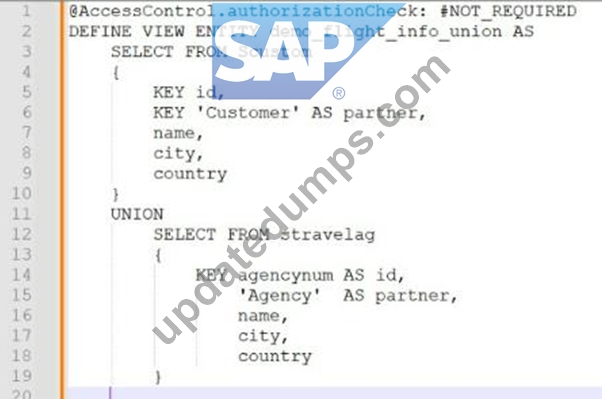
when you attempt to activate the definition, what will be the response?
- A. Activation error because the key fields of the union do not match
- B. Activation error because the field types of the union do not match
- C. Activation error because the field names of the union do not match
- D. Activation successful
Answer: C
Explanation:
The response will be an activation error because the field names of the union do not match. This is because the field names of the union must match in order for the definition to be activated. The union operator combines the result sets of two or more queries into a single result set. The queries that are joined by the union operator must have the same number and type of fields, and the fields must have the same names1. In the given code, the field names of the union do not match, because the first query has the fields carrname, connid, cityfrom, and cityto, while the second query has the fields carrname, carrier_id, cityfrom, and cityto. The field connid in the first query does not match the field carrier_id in the second query. Therefore, the definition cannot be activated.
NEW QUESTION # 22
What RESTful Application Programming object contains only the fields required for a particular app?
- A. Metadata extension
- B. Database view
- C. Data model view
- D. Projection View
Answer: D
Explanation:
A projection view is a RESTful Application Programming object that contains only the fields required for a particular app. A projection view is a CDS view entity that defines a projection on an existing CDS view entity or CDS DDIC-based view. A projection view exposes a subset of the elements of the projected entity, which are relevant for a specific business service. A projection view can also define aliases, virtual elements, and annotations for the projected elements. A projection view is the top-most layer of a CDS data model and prepares data for a particular use case. A projection view can have different provider contracts depending on the type of service it supports, such as transactional query, analytical query, or transactional interface.
A database view is a CDS DDIC-based view that defines a join or union of database tables. A database view has an SQL view attached and can be accessed by Open SQL or native SQL. A database view can be used as a projected entity for a projection view, but it does not contain only the fields required for a particular app.
A metadata extension is a RESTful Application Programming object that defines additional annotations for a CDS view entity or a projection view. A metadata extension can be used to enhance the metadata of a CDS data model without changing the original definition. A metadata extension does not contain any fields, but only annotations.
A data model view is a CDS view entity that defines a data model based on database tables or other CDS view entities. A data model view can have associations, aggregations, filters, parameters, and annotations. A data model view can be used as a projected entity for a projection view, but it does not contain only the fields required for a particular app.
References: CDS Projection Views - ABAP Keyword Documentation, CDS Projection Views in ABAP CDS:
What's Your Flavor, Business Object Projection - ABAP Keyword Documentation
NEW QUESTION # 23
You are given the following information:
1.
The data source "spfli" on line #2 is an SAP HANA
database table
2.
"spfli" will be a large table with over one million rows.
3.
This program is the only one in the system that accesses
the table.
4.
This program will run rarely.
Based on this information, which of the following general
settings should you set for the spfli database table? Note:
There are 2 correct answers to this question.
- A. "Load Unit to "Column Loadable"
- B. "Storage Type" to "Column Store"
- C. "Load Unit' to 'Page Loadable"
- D. "Storage Type" to "Row Store"
Answer: C,D
Explanation:
Based on the given information, the spfli database table should have the following general settings:
* "Storage Type" to "Row Store": This setting determines how the data is stored in the SAP HANA database. Row store is suitable for tables that are accessed by primary key or by a small number of columns. Column store is suitable for tables that are accessed by a large number of columns or by complex analytical queries. Since the spfli table is a large table with over one million rows, and this program is the only one in the system that accesses the table, it is likely that the program will use primary key access or simple queries to access the table. Therefore, row store is a better choice than column store for this table12.
* "Load Unit" to "Page Loadable": This setting determines how the data is loaded into the memory when the table is accessed. Page loadable means that the data is loaded in pages of 16 KB each, and only the pages that are needed are loaded. Column loadable means that the data is loaded in columns, and only the columns that are needed are loaded. Since the spfli table is a row store table, and this program will run rarely, it is more efficient to use page loadable than column loadable for this table. Page loadable will reduce the memory consumption and the loading time of the table13.
References: 1: Table Types in SAP HANA | SAP Help Portal 2: [Row Store vs Column Store in SAP HANA | SAP Blogs] 3: [Load Unit | SAP Help Portal]
NEW QUESTION # 24
In an Access Control Object, which clauses are used? Note: There are 3 correct answers to this question.
- A. Where (to specify the access conditions)
- B. Revoke (to remove access to the data source)
- C. Crant (to identify the data source)
- D. Define role (to specify the role name)
- E. Return code (to assign the return code of the authority check)
Answer: A,B,D
Explanation:
Explanation
An Access Control Object (ACO) is a CDS annotation that defines the access control rules for a CDS view entity. An ACO consists of one or more clauses that specify the role name, the data source, the access conditions, and the return code of the authority check12. Some of the clauses that are used in an ACO are:
Where (to specify the access conditions): This clause is used to define the logical expression that determines whether a user has access to the data source or not. The expression can use the fields of the data source, the parameters of the CDS view entity, or the predefined variables $user and $session. The expression can also use the functions check_authorization and check_role to perform additional authority checks12.
Define role (to specify the role name): This clause is used to assign a name to the role that is defined by the ACO. The role name must be unique within the namespace of the CDS view entity and must not contain any special characters. The role name can be used to reference the ACO in other annotations, such as @AccessControl.authorizationCheck or @AccessControl.grant12.
Revoke (to remove access to the data source): This clause is used to explicitly deny access to the data source for a user who meets the conditions of the where clause. The revoke clause overrides any grant clause that might grant access to the same user. The revoke clause can be used to implement the principle of least privilege or to enforce data segregation12.
You cannot do any of the following:
Grant (to identify the data source): This is not a valid clause in an ACO. The grant clause is a separate annotation that is used to grant access to a CDS view entity or a data source for a user who has a specific role. The grant clause can reference an ACO by its role name to apply the access conditions defined by the ACO12.
Return code (to assign the return code of the authority check): This is not a valid clause in an ACO. The return code of the authority check is a predefined variable that is set by the system after performing the access control check. The return code can be used in the where clause of the ACO to specify different access conditions based on the outcome of the check12.
References: 1: Access Control Objects - ABAP Keyword Documentation - SAP Online Help 2: Access Control in Core Data Services (CDS) | SAP Help Portal
NEW QUESTION # 25
Refer to the Exhibit.
Using ABAP SQL, which select statement selects the mat field on line #17?
- A. SELECT mat FROM demo_sales_so_i...
- B. SELECT mat FROM demo_sales_cds_so_i_ve...
- C. SELECT mat FROM Material...
- D. SELECT mat FROM demo sales cds material ve...
Answer: B
Explanation:
Using ABAP SQL, the select statement that selects the mat field on line #17 is:
SELECT mat FROM demo_sales_cds_so_i_ve...
This statement selects the mat field from the CDS view demo_sales_cds_so_i_ve, which is defined on line #1. The CDS view demo_sales_cds_so_i_ve is a projection view that projects the fields of the CDS view demo_sales_cds_so_i, which is defined on line #2. The CDS view demo_sales_cds_so_i is a join view that joins the fields of the database table demo_sales_so_i, which is defined on line #3, and the CDS view demo_sales_cds_material_ve, which is defined on line #4. The CDS view demo_sales_cds_material_ve is a value help view that provides value help for the material field of the database table demo_sales_so_i. The mat field is an alias for the material field of the database table demo_sales_so_i, which is defined on line #91.
The other options are not valid because:
A) SELECT mat FROM Material... is not valid because Material is not a valid data source in the given code. There is no CDS view or database table named Material.
C) SELECT mat FROM demo_sales_so_i... is not valid because demo_sales_so_i is not a valid data source in the given code. There is no CDS view named demo_sales_so_i, only a database table. To access a database table, the keyword TABLE must be used, such as SELECT mat FROM TABLE demo_sales_so_i...
D) SELECT mat FROM demo sales cds material ve... is not valid because demo sales cds material ve is not a valid data source in the given code. There is no CDS view or database table named demo sales cds material ve. The correct name of the CDS view is demo_sales_cds_material_ve, with underscores instead of spaces.
NEW QUESTION # 26 
with which predicate condition can you ensure that the CAST will work?
- A. IS SUPPLIED
- B. IS BOUND
- C. IS INSTANCE OF
- D. IS NOT INITIAL
Answer: C
Explanation:
Explanation
The predicate condition that can be used to ensure that the CAST will work is IS INSTANCE OF. The IS INSTANCE OF predicate condition checks whether the operand is an instance of the specified class or interface. This is useful when you want to perform a downcast, which is a conversion from a more general type to a more specific type. A downcast can fail if the operand is not an instance of the target type, and this can cause a runtime error. Therefore, you can use the IS INSTANCE OF predicate condition to check whether the downcast is possible before using the CAST operator12. For example:
The following code snippet uses the IS INSTANCE OF predicate condition to check whether the variable g_super is an instance of the class lcl_super. If it is, the CAST will work and the variable g_sub1 will be assigned the value of g_super.
DATA: g_super TYPE REF TO lcl_super, g_sub1 TYPE REF TO lcl_sub1. IF g_super IS INSTANCE OF lcl_super. g_sub1 = CAST #( g_super ). g_sub1->method( ... ). ENDIF.
You cannot do any of the following:
IS SUPPLIED: The IS SUPPLIED predicate condition checks whether an optional parameter of a method or a function module has been supplied by the caller. This is useful when you want to handle different cases depending on whether the parameter has a value or not. However, this predicate condition has nothing to do with the CAST operator or the type of the operand12.
IS NOT INITIAL: The IS NOT INITIAL predicate condition checks whether the operand has a non-initial value. This is useful when you want to check whether the operand has been assigned a value or not. However, this predicate condition does not guarantee that the CAST will work, because the operand may have a value but not be an instance of the target type12.
IS BOUND: The IS BOUND predicate condition checks whether the operand is a bound reference variable. This is useful when you want to check whether the operand points to an existing object or not. However, this predicate condition does not guarantee that the CAST will work, because the operand may point to an object but not be an instance of the target type12.
References: 1: Predicate Expressions - ABAP Keyword Documentation - SAP Online Help 2: ABAP - Predicates | SAP Community
NEW QUESTION # 27
You want to define the following CDS view entity with an input parameter:
Define view entity Z_CONVERT With parameters currency : ???
Which of the following can you use to replace "???? Note: There are 2 correct answers to this question.
- A. A data element
- B. A component of an ABAP Dictionary structure
- C. built-in ABAP type
- D. A built-in ABAP Dictionary type
Answer: A,C
Explanation:
The possible replacements for "???" in the CDS view entity definition with an input parameter are A. built-in ABAP type and C. A data element. These are the valid types that can be used to specify the data type of an input parameter in a CDS view entity. A built-in ABAP type is a predefined elementary type in the ABAP language, such as abap.char, abap.numc, abap.dec, etc. A data element is a reusable semantic element in the ABAP Dictionary that defines the technical attributes and the meaning of a field12. For example:
* The following code snippet defines a CDS view entity with an input parameter currency of type abap.
cuky, which is a built-in ABAP type for currency key:
Define view entity Z_CONVERT With parameters currency : abap.cuky as select from ... { ... }
* The following code snippet defines a CDS view entity with an input parameter currency of type waers, which is a data element for currency key:
Define view entity Z_CONVERT With parameters currency : waers as select from ... { ... } You cannot do any of the following:
* B. A built-in ABAP Dictionary type: This is not a valid type for an input parameter in a CDS view entity. A built-in ABAP Dictionary type is a predefined elementary type in the ABAP Dictionary, such as CHAR, NUMC, DEC, etc. However, these types cannot be used directly in a CDS view entity definition. Instead, they have to be prefixed with abap. to form a built-in ABAP type, as explained above12.
* D. A component of an ABAP Dictionary structure: This is not a valid type for an input parameter in a CDS view entity. A component of an ABAP Dictionary structure is a field that belongs to a structure type, which is a complex type that consists of multiple fields. However, an input parameter in a CDS view entity can only be typed with an elementary type, which is a simple type that has no internal structure12.
References: 1: ABAP CDS - SELECT, parameter_list - ABAP Keyword Documentation - SAP Online Help
2: ABAP Data Types - ABAP Keyword Documentation - SAP Online Help
NEW QUESTION # 28
In a subclass subl you want to redefine a component of a superclass superl. How do you achieve this? Note: There are 2 correct answers to this question.
- A. You add the clause REDEFINITION to the component in subl.
- B. You add the clause REDEFINITION to the component in superl.
- C. You implement the redefined component in subl.
- D. You implement the redefined component for a second time in superl.
Answer: A,C
Explanation:
To redefine a component of a superclass in a subclass, you need to do the following12:
You add the clause REDEFINITION to the component declaration in the subclass. This indicates that the component is inherited from the superclass and needs to be reimplemented in the subclass. The redefinition must happen in the same visibility section as the component declaration in the superclass. For example, if the superclass has a public method m1, the subclass must also declare the redefined method m1 as public with the REDEFINITION clause.
You implement the redefined component in the subclass. This means that you provide the new logic or behavior for the component that is specific to the subclass. The redefined component in the subclass will override the original component in the superclass when the subclass object is used. For example, if the superclass has a method m1 that returns 'Hello', the subclass can redefine the method m1 to return 'Hi' instead.
You cannot do any of the following:
You implement the redefined component for a second time in the superclass. This is not possible, because the superclass already has an implementation for the component that is inherited by the subclass. The subclass is responsible for providing the new implementation for the redefined component, not the superclass.
You add the clause REDEFINITION to the component in the superclass. This is not necessary, because the superclass does not need to indicate that the component can be redefined by the subclass. The subclass is the one that needs to indicate that the component is redefined by adding the REDEFINITION clause to the component declaration in the subclass.
NEW QUESTION # 29
Which of the following are parts of answers to this question.
- A. Extension
- B. Field list
- C. Partitioning attributes
- D. Semantic table attributes
Answer: A,B
Explanation:
A CDS view is a data definition that defines a data structure and a data selection from one or more data sources. A CDS view consists of several parts, but two of them are:
* Extension: An extension is an optional clause that allows a CDS view to extend another CDS view by adding new elements, annotations, or associations. The extension clause has the syntax EXTEND VIEW view_name WITH view_name. The first view_name is the name of the CDS view that is being extended, and the second view_name is the name of the CDS view that is doing the extension1.
* Field list: A field list is a mandatory clause that specifies the elements of the CDS view. The field list has the syntax SELECT FROM data_source { element_list }. The data_source is the name of the data
* source that the CDS view selects data from, and the element_list is a comma-separated list of elements that the CDS view exposes. The elements can be fields of the data source, expressions, associations, or annotations2.
The following example shows a CDS view that extends another CDS view and defines a field list:
@AbapCatalog.sqlViewName: 'ZCDS_EXT' define view Z_CDS_Extension extend view Z_CDS_Base with Z_CDS_Extension as select from ztable { // field list key ztable.id as ID, ztable.name as Name, ztable.age as Age, // extension @Semantics.currencyCode: true ztable.currency as Currency } The other options are not parts of a CDS view, but rather related concepts:
* Partitioning attributes: Partitioning attributes are attributes that are used to partition a table into smaller subsets of data. Partitioning attributes are defined in the ABAP Dictionary for transparent tables and can improve the performance and scalability of data access. Partitioning attributes are not part of the CDS view definition, but rather the underlying table definition3.
* Semantic table attributes: Semantic table attributes are attributes that provide additional information about the meaning and usage of a table. Semantic table attributes are defined in the ABAP Dictionary for transparent tables and can be used to enhance the data modeling and consumption of the table. Semantic table attributes are not part of the CDS view definition, but rather the underlying table definition4.
References: 1: Extending CDS Views | SAP Help Portal 2: SELECT List - ABAP Keyword Documentation 3:
Partitioning Attributes - ABAP Keyword Documentation 4: Semantic Table Attributes - ABAP Keyword Documentation
NEW QUESTION # 30
Which function call returns 0?
- A. find_any_of (val = "ABAP ABAP abap' sub = "AB")
- B. Count (val - 'ABAP ABAP abap' sub - 'AB' )
- C. find_any_not_of( val 'ABAP ABAP abap' sub = 'AB')
- D. Count_any_of ( val - 'ABAP ABAP abap' sub "AB" )
Answer: C
Explanation:
The function find_any_not_of returns the position of the first character in the string val that is not contained in the string sub. If no such character is found, the function returns 0. In this case, the string val contains only the characters A, B, and a, which are all contained in the string sub, so the function returns 0. The other functions return positive values, as follows:
* Count_any_of returns the number of occurrences of any character in the string sub within the string val.
In this case, it returns 8, since there are 8 A's and B's in val.
* Count returns the number of occurrences of the string sub within the string val. In this case, it returns 2, since there are 2 AB's in val.
* find_any_of returns the position of the first character in the string val that is contained in the string sub.
In this case, it returns 1, since the first character A is in sub. References: String Functions - ABAP Keyword Documentation, Examples of String Functions - ABAP Keyword Documentation
NEW QUESTION # 31 
The class zcl_demo_class is in a software component with the language version set to "Standard ABAP". The function module "ZF11 is in a software component with the language version set to "ABAP Cloud". Both the class and function module are customer created. Regarding line #6, which of the following is a valid statement?
- A. 'ZF1' can be called whether it has been released or not for cloud development.
- B. 'ZF1' must be released for cloud development to be called.
- C. 'ZF1' can be called via a wrapper that itself has not been released for cloud development.
- D. 'ZF1' can be called via a wrapper that itself has been released for cloud development.
Answer: D
Explanation:
Explanation
The function module ZF1 is in a software component with the language version set to "ABAP Cloud". This means that it follows the ABAP Cloud Development Model, which requires the usage of public SAP APIs and extension points to access SAP functionality and data. These APIs and extension points are released by SAP and documented in the SAP API Business Hub1. Customer-created function modules are not part of the public SAP APIs and are not released for cloud development. Therefore, calling a function module directly from a class with the language version set to "Standard ABAP" is not allowed and will result in a syntax error.
However, there is a possible way to call a function module indirectly from a class with the language version set to "Standard ABAP":
Create a wrapper class or interface for the function module and release it for cloud development. A wrapper is a class or interface that encapsulates the function module and exposes its functionality through public methods or attributes. The wrapper must be created in a software component with the language version set to "ABAP Cloud" and must be marked as released for cloud development using the annotation @EndUserText.label. The wrapper can then be called from a class with the language version set to "Standard ABAP" using the public methods or attributes2.
For example, the following code snippet shows how to create a wrapper class for the function module ZF1 and call it from the class zcl_demo_class:
@EndUserText.label: 'Wrapper for ZF1' CLASS zcl_wrapper_zf1 DEFINITION PUBLIC FINAL CREATE PUBLIC. PUBLIC SECTION. CLASS-METHODS: call_zf1 IMPORTING iv_a TYPE i iv_b TYPE i EXPORTING ev_result TYPE i. ENDCLASS.
CLASS zcl_wrapper_zf1 IMPLEMENTATION. METHOD call_zf1. CALL FUNCTION 'ZF1' EXPORTING a = iv_a b = iv_b IMPORTING result = ev_result. ENDMETHOD. ENDCLASS.
CLASS zcl_demo_class DEFINITION. METHODS: m1. ENDCLASS.
CLASS zcl_demo_class IMPLEMENTATION. METHOD m1. DATA(lv_result) =
zcl_wrapper_zf1=>call_zf1( iv_a = 2 iv_b = 3 ). WRITE: / lv_result. ENDMETHOD. ENDCLASS.
The output of this code is:
5
References: 1: SAP API Business Hub 2: Creating an ABAP Cloud Project | SAP Help Portal
NEW QUESTION # 32
You want to provide a short description of the data definition for developers that will be attached to the database view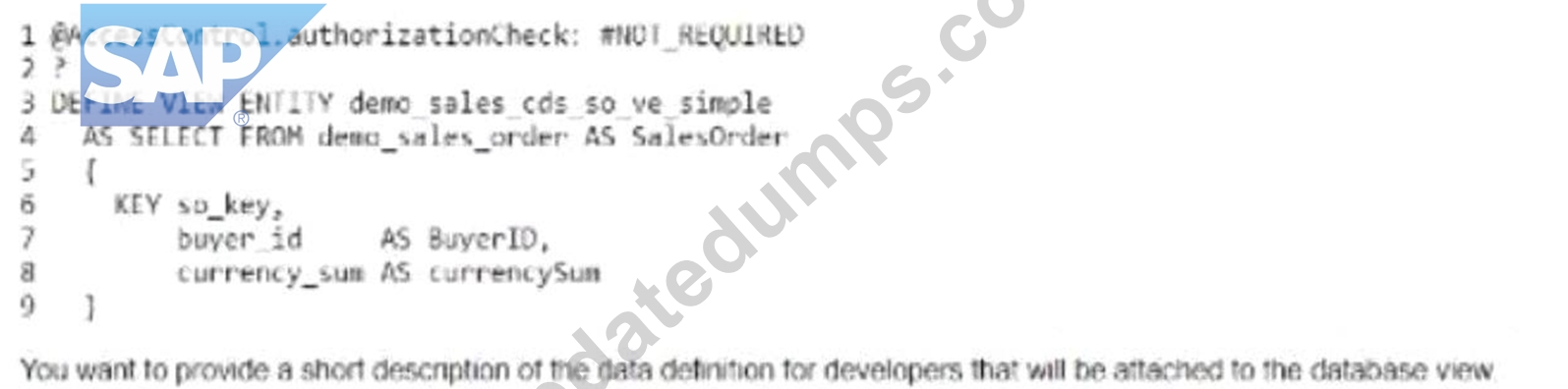
Which of the following annotations would do this if you inserted it on line #27
- A. @UI headerinto description label
- B. @UI.badge.title.label
- C. @EndUserText.quickInfo
- D. @EndUserText label
Answer: D
Explanation:
The annotation that can be used to provide a short description of the data definition for developers that will be attached to the database view is the @EndUserText.label annotation. This annotation is used to specify a text label for the data definition that can be displayed in the development tools or in the documentation. The annotation can be inserted on line #27 in the code snippet provided in the question12. For example:
* The following code snippet uses the @EndUserText.label annotation to provide a short description of the data definition for the CDS view ZCDS_VIEW:
@AbapCatalog.sqlViewName: 'ZCDS_VIEW' @AbapCatalog.compiler.compareFilter: true @AbapCatalog.
preserveKey: true @AccessControl.authorizationCheck: #CHECK @EndUserText.label: 'CDS view for flight data' "short description for developers define view ZCDS_VIEW as select from sflight { key carrid, key connid, key fldate, seatsmax, seatsocc } You cannot do any of the following:
* @UI.headerInfo.description.label: This annotation is used to specify a text label for the description field of the header information of a UI element. This annotation is not relevant for the data definition of a database view12.
* @UI.badge.title.label: This annotation is used to specify a text label for the title field of a badge UI element. This annotation is not relevant for the data definition of a database view12.
* @EndUserText.quickInfo: This annotation is used to specify a quick information text for the data definition that can be displayed as a tooltip in the development tools or in the documentation. This annotation is not the same as a short description or a label for the data definition12.
References: 1: ABAP CDS - SAP Annotations - ABAP Keyword Documentation - SAP Online Help 2: ABAP CDS - Data Definitions - ABAP Keyword Documentation - SAP Online Help
NEW QUESTION # 33
In a test method you call method cl_abap_unit_assert=>assert_equals( .. ) in the following way:
CLASS Itcl1 DEFINITION FOR TESTING RISK LEVEL HARMLESS DURATION SHORT.
PRIVATE SECTION.
METHODS m1 FOR TESTING.
ENDCLASS.
CLASS Itcl1 IMPLEMENTATION.
METHOD m1.
DATA: go_test_object TYPE REF TO zcl_to_be_tested.
CONSTANTS: Ico_exp TYPE string VALUE 'test2'.
CREATE OBJECT go_test_object.
cl_abap_unit_assert=>assert_equals(
EXPORTING
act = go_class->mv_attribute
exp = lco_exp
msg = 'assert equals failed ' && go_test_object->mv_attribute && ' ' && lco_exp ENDMETHOD.
ENDCLASS.
What will happen if method parameters act and exp are not equal?
- A. The test will be aborted.
- B. There will be a message in the test log.
- C. The tested unit cannot be transported.
- D. The tested unit will automatically be appended to a default ABAP Test Cockpit Variant.
Answer: B
NEW QUESTION # 34
In ABAP SQL, which of the following retrieves the association field_Airline-Name of a CDS view?
- A. \_Airline-Name
- B. @_Airline-Name
- C. "_Airline Name
- D. /_Airline Name
Answer: B
Explanation:
In ABAP SQL, the syntax to retrieve the association field of a CDS view is to use the @ sign followed by the association name and the field name, separated by a period sign (.). For example, to retrieve the association field _Airline-Name of a CDS view, the syntax is @_Airline.Name. This syntax allows the access to the fields of the target data source of the association without explicitly joining the data sources1. The other options are incorrect because they use the wrong symbols or formats to access the association field.
NEW QUESTION # 35
Which patterns raise an exception? Note: There are 3 correct answers to this question.
- A. DATA: gv_target TYPE d. s/ □ CONSTANTS: gco_date TYPE d VALUE '20331233*. gv_target EXACT ( geo_date).
- B. DATA: gv_target TYPE string. □ CONSTANTS: gco_string TYPE LENGTH 16 VALUE 0123456789ABCDEF*. gv_target = EXACT # gco_string+5 (5) ).
- C. DATA: gv_target TYPE c LENGTH 5. V □ CONSTANTS: ECO string TYPE string VALUE 0123456789ABCDEF". gv_target - EXACT (gco_string + 5 (6) ).
- D. DATA: gv_target TYPE p DECIMALS 2. CONSTANTS: go intl TYPE i VALUE 3. gv_target -U EXACT (2 gcojntl).
- E. DATA: Ev target TYPE p DECIMALS 3. CONSTANTS: gcojntl TYPE i VALUE 2. Ev_target -U EXACT #2 / gcojntl ).
Answer: A,C,D
Explanation:
The patterns that raise an exception are those that use the constructor operator EXACT to perform a lossless assignment or calculation, but the result cannot be converted to the target data type without data loss. The following are the explanations for each pattern:
A: This pattern raises the exception CX_SY_CONVERSION_LOST because the result of the calculation 2 * 3 is 6, which cannot be assigned to a packed number with two decimal places without losing the integer part. The operator -U is used to perform a lossless calculation with the calculation type decfloat34.
B: This pattern does not raise an exception because the result of the substring expression gco_string+5(5) is '6789A', which can be assigned to a string without data loss. The operator EXACT # is used to perform a lossless assignment with the data type of the argument.
C: This pattern raises the exception CX_SY_CONVERSION_LOST because the result of the substring expression gco_string+5(6) is '6789AB', which cannot be assigned to a character field with length 5 without losing the last character. The operator EXACT is used to perform a lossless assignment with the data type of the target field.
D: This pattern does not raise an exception because the result of the calculation 2 / 2 is 1, which can be assigned to a packed number with three decimal places without data loss. The operator -U is used to perform a lossless calculation with the calculation type decfloat34.
E: This pattern raises the exception CX_SY_CONVERSION_ERROR because the constant gco_date contains an invalid value '20331233' for a date data type, which cannot be converted to a valid date. The operator EXACT is used to perform a lossless assignment with the data type of the target field.
NEW QUESTION # 36
You want to define the following CDS view entity with an input parameter:
Define view entity Z_CONVERT With parameters currency : ???
Which of the following can you use to replace "???? Note: There are 2 correct answers to this question.
- A. A data element
- B. A component of an ABAP Dictionary structure
- C. built-in ABAP type
- D. A built-in ABAP Dictionary type
Answer: A,C
Explanation:
Explanation
The possible replacements for "???" in the CDS view entity definition with an input parameter are A. built-in ABAP type and C. A data element. These are the valid types that can be used to specify the data type of an input parameter in a CDS view entity. A built-in ABAP type is a predefined elementary type in the ABAP language, such as abap.char, abap.numc, abap.dec, etc. A data element is a reusable semantic element in the ABAP Dictionary that defines the technical attributes and the meaning of a field12. For example:
The following code snippet defines a CDS view entity with an input parameter currency of type abap.cuky, which is a built-in ABAP type for currency key:
Define view entity Z_CONVERT With parameters currency : abap.cuky as select from ... { ... } The following code snippet defines a CDS view entity with an input parameter currency of type waers, which is a data element for currency key:
Define view entity Z_CONVERT With parameters currency : waers as select from ... { ... } You cannot do any of the following:
B). A built-in ABAP Dictionary type: This is not a valid type for an input parameter in a CDS view entity. A built-in ABAP Dictionary type is a predefined elementary type in the ABAP Dictionary, such as CHAR, NUMC, DEC, etc. However, these types cannot be used directly in a CDS view entity definition. Instead, they have to be prefixed with abap. to form a built-in ABAP type, as explained above12.
D). A component of an ABAP Dictionary structure: This is not a valid type for an input parameter in a CDS view entity. A component of an ABAP Dictionary structure is a field that belongs to a structure type, which is a complex type that consists of multiple fields. However, an input parameter in a CDS view entity can only be typed with an elementary type, which is a simple type that has no internal structure12.
References: 1: ABAP CDS - SELECT, parameter_list - ABAP Keyword Documentation - SAP Online Help 2:
ABAP Data Types - ABAP Keyword Documentation - SAP Online Help
NEW QUESTION # 37
Which function call returns 0?
- A. find_any_of (val = "ABAP ABAP abap' sub = "AB")
- B. Count (val - 'ABAP ABAP abap' sub - 'AB' )
- C. find_any_not_of( val 'ABAP ABAP abap' sub = 'AB')
- D. Count_any_of ( val - 'ABAP ABAP abap' sub "AB" )
Answer: C
Explanation:
The function find_any_not_of returns the position of the first character in the string val that is not contained in the string sub. If no such character is found, the function returns 0. In this case, the string val contains only the characters A, B, and a, which are all contained in the string sub, so the function returns 0. The other functions return positive values, as follows:
Count_any_of returns the number of occurrences of any character in the string sub within the string val. In this case, it returns 8, since there are 8 A's and B's in val.
Count returns the number of occurrences of the string sub within the string val. In this case, it returns 2, since there are 2 AB's in val.
find_any_of returns the position of the first character in the string val that is contained in the string sub. In this case, it returns 1, since the first character A is in sub. Reference: String Functions - ABAP Keyword Documentation, Examples of String Functions - ABAP Keyword Documentation
NEW QUESTION # 38
In what order are objects created to generate a RESTful Application Programming application?
- A. Data model view 2
- B. A D C B
- C. Database table 1
- D. Service definition 3
- E. D A B C
- F. Service binding Projection view 4
- G. C B A B
- H. B D C A
Answer: D
Explanation:
Explanation
The order in which objects are created to generate a RESTful Application Programming application is A, D, C, B. This means that the following steps are followed:
First, a database table is created to store the data for the application. A database table is a CDS DDIC-based view that defines a join or union of database tables. A database table has an SQL view attached and can be accessed by Open SQL or native SQL.
Second, a data model view is created to define a data model based on the database table or other CDS view entities. A data model view is a CDS view entity that can have associations, aggregations, filters, parameters, and annotations. A data model view can also define the behavior definition and implementation for the business object.
Third, a service definition is created to define the service interface for the application. A service definition is a CDS view entity that defines a projection on a data model view or another service definition. A service definition can also define service metadata, such as service name, version, description, and annotations.
Fourth, a service binding is created to define the service binding for the application. A service binding is a CDS view entity that defines a projection on a service definition. A service binding can also define the service protocol, such as OData V2, OData V4, or REST, and the service URL.
References: CDS Data Model Views - ABAP Keyword Documentation, CDS Service Definitions - ABAP Keyword Documentation, CDS Service Bindings - ABAP Keyword Documentation, CDS Projection Views - ABAP Keyword Documentation
NEW QUESTION # 39
......
C_ABAPD_2309 Exam Practice Questions prepared by SAP Professionals: https://pass4sure.updatedumps.com/SAP/C_ABAPD_2309-updated-exam-dumps.html