

Latest AD0-E724 exam dumps with real Adobe questions and answers
AD0-E724 Exam in First Attempt Guaranteed
NEW QUESTION # 22
An integration named Marketing is created on the Adobe Commerce instance. The integration has access on Magento_Customer:: customer resources and the access token is xxxxxx.
How would the rest API be called to search the customers?
- A. Type: application/json'
Use the admin token as Bearer
curl -X GET https://magentourl/rest/Vl/customers/search?searchCriteria... -H 'Authorization: Bearer YYYYYY' - B. Passing integration name and access token as http auth credentials:
curl -X GET https ://Marketing:XXXXXX(Slmagentourl/rest/Vl/customers/search?5earchCriteria . . .
Using integration name as username and access token as password, get the admin token (yyyyyy) via:
curl -X POST https://magentourl/rest/Vl/integration/admin/token -d '{"username":"Marketing",
"password":"XXXXXX"}' -H 'Content- - C. Using the integration access token as Bearer:
curl -X GET https://magentourl/rest/Vl/customers/search?searchCriteria... -H 'Authorization: Bearer XXXXXX'
Answer: C
Explanation:
When using an integration token to access Magento's REST API, you can authenticate requests by including the token in the Authorization header as a Bearer token. This allows the system to recognize the permissions assigned to the integration and grant access to the specified resources.
* Using the Access Token as Bearer Token:
* In Magento, integration tokens are treated as Bearer tokens for API authentication. Once the token is generated, you can directly use it in the Authorization header.
* The access token XXXXXX will provide access to resources allowed by the Magento_Customer::
customer permission.
* Why Option A is Correct:
* Option A shows the correct way to authenticate an API call using a pre-existing integration token by setting the header Authorization: Bearer XXXXXX. This is a straightforward way to search for customers without additional steps.
* Options B and C describe methods that are not necessary for this scenario. The access token already has the necessary permissions, so there's no need to re-authenticate or obtain an admin token.
* Example Command:
curl -X GET "https://magentourl/rest/V1/customers/search?searchCriteria[filterGroups][0][filters][0][field]
=email&searchCriteria[filterGroups][0][filters][0][value][email protected]" -H "Authorization:
Bearer XXXXXX"
NEW QUESTION # 23
An Adobe Commerce developer is trying to create a custom table using declarative schema, but is unable to do so.
What are two errors in the snippet above? (Choose two.)
- A. null is not a valid value for column (roll_no).
- B. Column (student_name) does not have attribute length.
- C. Column (roll_no) does not have index. It is needed since attribute identity is set to true.
- D. Column (entity_id) does not have index. It is needed since attribute identity is set to false.
Answer: B,C
Explanation:
The correct answers are A and C.
The errors in the snippet are:
* Column roll_no does not have an index. It is needed since attribute_identity is set to true.
* Column student_name does not have an attribute length.
Theattribute_identityattribute specifies whether the primary key of the table should be auto-incremented.
Ifattribute_identityis set totrue, then theroll_nocolumn must have an index. Thestudent_namecolumn does not have an attribute length, which is required for string columns.
The following code shows how to fix the errors:
XML
<table name="vendor_module_table">
<entity_id>
<type>int</type>
<identity>true</identity>
<unsigned>true</unsigned>
<nullable>false</nullable>
</entity_id>
<roll_no>
<type>int</type>
<identity>false</identity>
<unsigned>true</unsigned>
<nullable>false</nullable>
<primary_key>true</primary_key>
<index>true</index>
</roll_no>
<student_name>
<type>string</type>
<length>255</length>
<nullable>false</nullable>
</student_name>
</table>
Once the errors have been fixed, the table can be created successfully.
NEW QUESTION # 24
On an Adobe Commerce Cloud platform, at what level is the variable env: composer_auth located in the Project Web Interface?
- A. In the Environment-specific variables.
- B. In the Project variables.
- C. In the Integration variables.
Answer: B
Explanation:
The variable env: composer_auth is located in the Project variables section in the Project Web Interface. This variable is used to store the authentication credentials for Composer repositories that require access keys or tokens. The developer can set this variable at the project level to apply it to all environments, or override it at the environment level if needed. Verified References: [Magento 2.4 DevDocs] 2
NEW QUESTION # 25
Which two methods add sorting to collections inherited from the
\Magento\Framework\Model\ResourceModel\Db\Collection\AbstractCollection class? (Choose two.)
- A. addSorting
- B. setSorting
- C. addOrder
- D. setOrder
Answer: C,D
Explanation:
The two methods that add sorting to collections inherited from the
\Magento\Framework\Model\ResourceModel\Db\Collection\AbstractCollection class are setOrder and addOrder. These methods allow adding one or more order clauses to a collection query.
The setSorting and addSorting methods do not exist in Adobe Commerce.
Verified References: [Adobe Commerce Developer Guide - Collections]
In Magento 2, collections inherited from
\Magento\Framework\Model\ResourceModel\Db\Collection\AbstractCollectionclass can be sorted using thesetOrderandaddOrdermethods. ThesetOrdermethod is used to set the order for a field in the collection, specifying the field by which to sort and the direction of the sorting (ASC or DESC). TheaddOrdermethod is similar but allows for adding multiple sorting orders to the collection, enabling more complex sorting scenarios. There are nosetSortingoraddSortingmethods in the standard Magento 2 collection classes.
NEW QUESTION # 26
An Adobe Commerce developer is working on a Magento 2 instance which contains a B2C and a B2B website, each of which contains 3 different store views for English, Welsh, and French language users. The developer is tasked with adding a link between the B2C and B2B websites using a generic link template which is used throughout the sites, but wants these links to display in English regardless of the store view.
The developer creates a custom block for use with this template, before rendering sets the translate locale and begins environment emulation using the following code:
They find that the template text is still being translated into each stores language. Why does this occur?
- A. setLocate() does not change translation locale after it has been initially set, the $this->_translate-
>emulate($newLocaiecode) method exists to temporarily modify this by pushing the new locale to the top of the current emuiatedLocales stack. - B. startEnvironmffntEmulation() SetS and locks the locale by Using the setLocale() Optional Second
$lock parameter, i.e. setLocale($newLocaleCode,
true), to override and lock the locale of the emulated store. If this is set and locked initially then the environment emulation will not be able to override this. - C. startEnvironmentEmuiation() resets the translation locale to the one of the emulated stores, which overrides the locale the developer has set when the order of setLocate and startEnvironmentEmulation is used as displayed above.
Answer: C
Explanation:
ThestartEnvironmentEmulation()method resets the translation locale to the one of the emulated stores, which overrides the locale the developer has set when the order ofsetLocale()andstartEnvironmentEmulation()is used as displayed above.
The correct way to achieve the desired result is to use theemulate()method to temporarily modify the translation locale. The following code shows how to do this:
PHP
$this->_translate->emulate('en_US');
// Render the template
$this->_translate->revert();
This code will set the translation locale to English before rendering the template, and then revert the locale back to the default value after the template has been rendered.
ThestartEnvironmentEmulation()method is used to emulate a different store view or website. This can be useful for testing purposes, or for developing features that need to work in different environments.
Theemulate()method is used to temporarily modify the translation locale. This can be useful for rendering templates in a specific language, or for testing features that need to work in different languages.
NEW QUESTION # 27
What are two ways to access the PHP error logs on Adobe Commerce Cloud? (Choose Two.)
- A. Use the dedicated command from Cloud CLI for Commerce.
- B. Connect to the the servers via SSH and localize the log files.
- C. Navigate to the dedicated entry in the Project Web Interface.
- D. Use the Adobe Admin Log application.
Answer: A,B
Explanation:
Two ways to access the PHP error logs on Adobe Commerce Cloud are to use the dedicated command from Cloud CLI for Commerce and to connect to the servers via SSH and localize the log files. The Cloud CLI for Commerce is a command-line tool that allows developers to interact with their Adobe Commerce Cloud projects and environments. The developer can use the command magento-cloud log php to view or download the PHP error logs from any environment.
In Adobe Commerce Cloud, accessing PHP error logs can be done through the Cloud CLI or by directly connecting to the server via SSH.
* Cloud CLI for Accessing Logs:
* The Cloud CLI provides commands to access various logs, including PHP error logs, which can be accessed easily without directly connecting to the server.
* SSH for Direct Log Access:
* For more hands-on control or specific log inspection, SSH allows you to connect to the server and directly access log files located typically in the /var/log directory on Adobe Commerce Cloud environments.
* Why Options A and C are Correct:
* These two methods provide direct and official ways to access error logs on Adobe Commerce Cloud.
* Option B is incorrect as the Project Web Interface does not have a dedicated PHP error log entry.
Option D is incorrect as there is no Adobe Admin Log application.
NEW QUESTION # 28
On the Adobe Commerce Cloud Project Web Interface, what will be performed when clicking on the "Delete" button of an integration environment?
- A. The environment is marked as "inactive", the git branch is still present but the database is deleted.
- B. The environment is marked as "inactive", the git branch and the database are still present.
- C. The environment is completely deleted. Including git branch and database.
Answer: C
Explanation:
On the Adobe Commerce Cloud Project Web Interface, clicking on the "Delete" button of an integration environment will completely delete the environment, including the associated git branch and database. This action is irreversible and is used to remove an environment that is no longer needed. The environment, once deleted, frees up resources for the project and cannot be restored.
NEW QUESTION # 29
A developer is working on a task that includes a custom controller creation. A controller should forward the request to a different action.
How can the developer complete this task?
- A. Return the forward object with action as an argument in the object's forward method
- B. Specify the forward action in the controllerjorward.xml configuration file.
- C. Implement a forwardToAction method in the controller, and return the action where the request should be forwarded.
Answer: A
Explanation:
To forward the request to a different action, the developer can use the following code in the controller:
return $resultForward->forward('action');
where $resultForward is an instance of \Magento\Framework\Controller\Result\ForwardInterface and 'action' is the name of the action where the request should be forwarded.
There is no controllerjorward.xml configuration file or forwardToAction method in Adobe Commerce.
Verified References: [Adobe Commerce Developer Guide - Forward action result] In Magento, to forward a request from one controller action to another, a developer can utilize the forward method available in the controller action class. This is achieved by returning a result from the action method that instructs Magento to forward the request to another action. The forward object is obtained by calling the
$this->resultForwardFactory->create()method within the controller action. Then, the target action is specified by calling theforwardmethod on this object with the action name as the argument, such as
$resultForward->forward('targetAction'). This approach is consistent with Magento's emphasis on using result objects to control the flow of request processing within its MVC architecture.
NEW QUESTION # 30
An Adobe Commerce developer has been asked to modify the PageBuilder slider content type to allow a new custom content type (other than slide) to be assigned as a child. The developer has already created the new content type called improved_slide in their module. They now need to create a new view/adminhtml
/pagebuilder/content_type/slider. xml file in their module to allow the new content type to be a child of slider content types.
What is the correct xml to accomplish this?
- A.

- B.

- C.
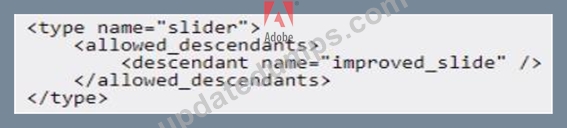
Answer: A
Explanation:
The correct answer is Option C. This XML configuration is the correct way to define allowed child content types for a slider content type in Magento's PageBuilder.
Magento PageBuilder Content Type Structure:
In PageBuilder, each content type can specify which other content types are allowed as children.
This is done by defining the allowed_children array within the content type's XML configuration.
Analyzing Option C:
Arguments Definition: Option C uses the <arguments> node to define a new argument named allowed_children.
Array Structure: This argument is an array (xsi:type="array") that includes an item specifying the improved_slide as an allowed child with xsi:type="string".
This configuration is correct because it explicitly defines which child content types are allowed for the slider content type, adhering to Magento's structure for allowed child elements in PageBuilder.
Why Options A and B are Incorrect:
Option A: Uses a <children> node with policy="allow", which is not the standard way to define allowed children for PageBuilder content types. This format is incorrect and won't be recognized by PageBuilder.
Option B: Uses <allowed_descendants>, which also doesn't align with the way Magento's PageBuilder expects child content types to be declared. The correct term is allowed_children, not allowed_descendants.
NEW QUESTION # 31
An Adobe Commerce developer wants to generate a list of products using ProductRepositorylnterf ace and search for products using a supplier_id filter for data that is stored in a standalone table (i.e., not in an EAV attribute).
Keeping maintainability in mind, how can the developer add the supplier ID to the search?
- A. Write a before plugin On \Magento\Framework\Api\SearchCriteria\CollectionProcessorInterface: :
process(). Iterate through the $searchCriteria
provided for supplier_id, and if found, apply the needed join and filter to the passed scollection. - B. Write a before plugin on \Hagento\catalogVtodel\ProductRepository: :geti_ist() and register the search criteria passed. Write an event observer to 0 listen for the event cataiog_product_coiiection_ioad_before. Iterate through the registered search criteria, and if found, apply the needed join and filter to the events scollection.
- C. Add a CUStOm filter to the Virtual type
"agento\Catalog\Model\Api\SearchCriteria\CollectionProcessor\ProductFilterProce5sor for supplier_id field. In the custom filter, apply the needed join and filter to the passed $collection.
Answer: C
Explanation:
The developer can add a custom filter to the virtual type
Magento\Catalog\Model\Api\SearchCriteria\CollectionProcessor\ProductFilterProce5sor for supplier_id field.
In the custom filter, the developer can apply the needed join and filter to the passed $collection. This is the recommended way to extend the search criteria for products using dependency injection and plugins. Verified References: [Magento 2.4 DevDocs] [Magento Stack Exchange] In Adobe Commerce, when you need to add a custom filter for a non-EAV attribute stored in a standalone table, the most maintainable approach is to create a custom filter for ProductFilterProcessor. This processor allows for customized search criteria handling, which can be extended to include custom joins and filters without altering core functionality or relying on plugins and observers.
* Why Custom Filter in ProductFilterProcessor is Preferred:
* The ProductFilterProcessor within SearchCriteria\CollectionProcessor is specifically designed to handle filtering of product collections. By extending this with a custom filter, the developer can implement joins and filters on standalone tables.
* This approach is modular and reusable, allowing any code that utilizes ProductRepositoryInterface to apply the supplier_id filter seamlessly.
* Implementation of Custom Filter:
* Define a custom filter class that implements the required logic to join the standalone table and apply the supplier_id filter.
* Register this custom filter with a virtual type in di.xml for ProductFilterProcessor, so it can process the supplier_id as part of the search criteria.
* Why Options A and C are Less Suitable:
* Option A relies on an event observer, which is less modular and may have performance implications since it requires listening to every product collection load event.
* Option C, while functional, involves modifying CollectionProcessorInterface::process(), which is more generic and not specifically tailored for product collection filtering.
NEW QUESTION # 32
ECE-Tools provides a set of tools that can be used to manage and maintain your Adobe Commerce Cloud environment. What are some of the features provided by ECE-Tools?
- A. Builds application, Applies custom patches, and Shows the list of S3 backup tar.gz files.
- B. Fastly configuration, Applies custom patches and Dump configuration for static content deployment.
- C. Builds application, Applies custom patches and Dump configuration for static content deployment.
Answer: C
Explanation:
Some of the features provided by ECE-Tools are building application, applying custom patches, and dumping configuration for static content deployment. ECE-Tools is a set of scripts and tools designed to manage and deploy Adobe Commerce Cloud projects. It provides commands for building application code, applying patches for Magento core issues or custom modules, and dumping configuration settings for static content deployment optimization. Verified References: [Magento 2.4 DevDocs] 2 The ECE-Tools package for Adobe Commerce Cloud provides a range of tools and scripts to manage and streamline deployment and maintenance tasks. Among its key features:
* Application Builds:
* ECE-Tools handles the build process, which includes compiling the code, preparing static content, and configuring deployment.
* Applying Custom Patches:
* It includes capabilities for managing and applying custom patches to the Adobe Commerce application during deployment, which is essential for customization and bug fixes.
* Dump Configuration for Static Content Deployment:
* ECE-Tools can dump configuration for static content deployment, optimizing the static content deployment process by handling configurations and assets efficiently.
* Why Option A is Correct:
* Option A lists these core functionalities provided by ECE-Tools. Option B incorrectly includes Fastly configuration, which is managed separately. Option C mentions S3 backups, which are not directly handled by ECE-Tools.
NEW QUESTION # 33
Which two attribute input types can be used for a date? (Choose two.)
- A. Schedule
- B. Date
- C. Date and Time
- D. Timezone
Answer: B,C
Explanation:
The two attribute input types that can be used for a date are Date and Time and Date. These input types allow the user to select a date or a date and time from a calendar widget.
The Timezone and Schedule input types do not exist in Adobe Commerce.
Verified References: [Adobe Commerce User Guide - Create a product attribute] In Magento, attribute input types define the type of data an attribute can hold and how it should be inputted or displayed in the UI. For dates, Magento provides specific input types to handle date-related data efficiently.
The "Date" input type is used for attributes that require only a date, without a time component, suitable for birthdays, anniversaries, or any date-specific information. The "Date and Time" input type, on the other hand, includes both date and time components, ideal for events, promotions, or any scenario where the time of day is relevant. These input types ensure data consistency and provide a user-friendly interface for selecting dates and times.
NEW QUESTION # 34
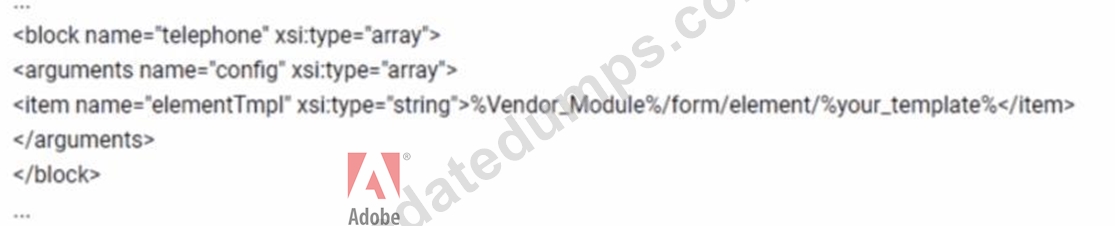
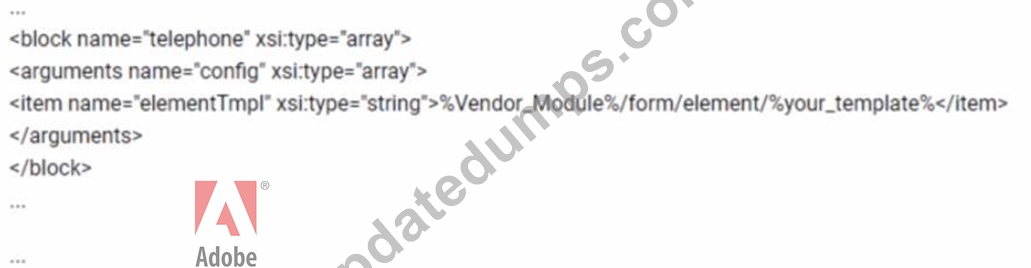
A client would like to add an image icon in front of the telephone field to the shipping address form on a checkout page. What is the correct way to modify the Ul component to set a custom template file for the field?
- A.
- B.
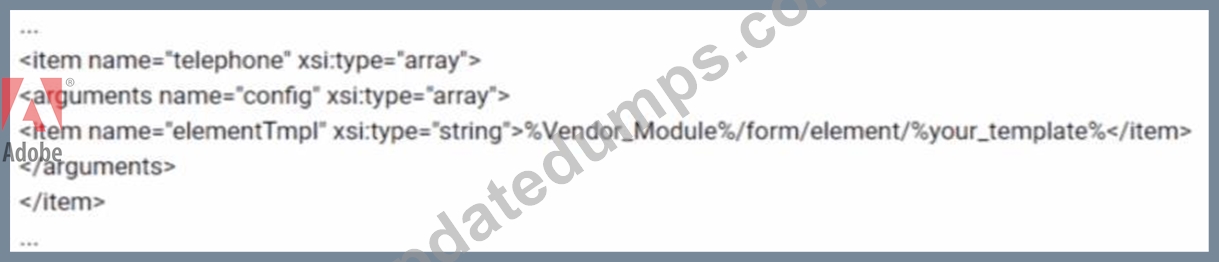
- C.
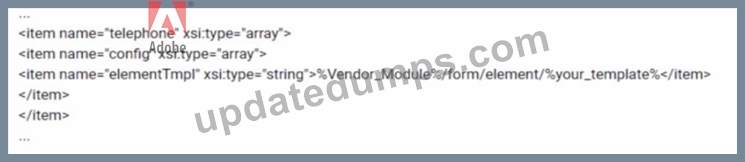
- D.
Answer: D
Explanation:
To add an image icon in front of the telephone field in the shipping address form on the checkout page, the correct way is to modify the UI component by setting a custom template file for the field. The snippet in option B is the correct one because it uses the<block>element and sets theelementTmplto the custom template path within theargumentsnode under theconfignode. This modification will instruct Magento to use the specified custom template file for rendering the telephone field, allowing for the addition of an image icon in front of it.
NEW QUESTION # 35
An Adobe Commerce Cloud project is using Enhanced Integration Environments with two install a new payment module.
The developer is using Cloud CLI for Commerce tool.
What would a developer do to test this new feature under the integration environment?
- A. 1. Create a new branch from integration and install the module.
2. Push the changes.
3. Branch active status check is not necessary. - B. 1. Duplicate one of the integration environment branches.
2. Create a new active branch from integration and install the module.
3. Push the changes. - C. 1. Deactivate one of the active integration environment branches.
2. Create a new active branch from integration and install the module.
3. Push the changes.
Answer: C
Explanation:
The developer can test the new feature under the integration environment by deactivating one of the active integration environment branches, creating a new active branch from integration and installing the module, and pushing the changes. This is because Enhanced Integration Environments have a limit of four active branches at a time, and each branch has its own dedicated database and services. The developer can use the Cloud CLI for Commerce tool to manage the branches and deploy the code changes. Verified References:
[Magento 2.4 DevDocs] 1
Enhanced Integration Environments in Adobe Commerce Cloud have a limit on the number of active branches. If both integration branches are currently active, one must be deactivated to create a new active branch for testing.
* Creating a New Active Integration Branch:
* If there are already two active branches, deactivate one to free up space for a new branch.
* Then create a new branch from the integration environment, apply the changes (such as installing the new module), and push the changes.
* Why Option C is Correct:
* Adobe Commerce Cloud limits the number of active integration branches. Deactivating an existing branch is necessary before creating a new active branch for testing.
* Option A suggests duplicating a branch without addressing the active branch limitation, while Option B disregards the need to check branch active status, which could prevent successful deployment.
NEW QUESTION # 36
What is the command used to upgrade ECE-Tools on an Adobe Commerce Cloud platform?
- A. php ./vendor/bin/ece-tools upgrade
- B. magento-cloud ece-tools:upgrade
- C. composer update magento/ece-tools --with-all-dependencies
Answer: C
Explanation:
To upgrade ece-tools on Adobe Commerce Cloud, the recommended command is to use Composer to ensure that all dependencies are resolved and updated accordingly. The command composer update magento/ece- tools --with-all-dependencies will update ece-tools along with any other dependencies required.
* Using Composer for Dependency Management:
* Composer is the standard package manager for PHP and is used to manage dependencies, including ece-tools in Adobe Commerce Cloud. This command ensures that any required dependency updates are also applied.
* Why Option B is Correct:
* Option B leverages Composer's ability to handle dependencies, which is essential to avoid version conflicts.
* Option A (php ./vendor/bin/ece-tools upgrade) does not exist for ece-tools. Option C is incorrect because magento-cloud ece-tools:upgrade is not a valid command for updating ece-tools.
NEW QUESTION # 37
How would a developer turn on outgoing emails on an Adobe Commerce Cloud Staging environment?
- A. From the command line
ece-tools enable_smtp true - B. From the command line
magento-cloud environment:info -p <project-id> -e <environment-id> enable_smtp true - C. Access the Project Web Interface and select the Staging environment.
Select Configure environment.
Toggle Outgoing emails On
Answer: C
Explanation:
The developer can turn on outgoing emails on an Adobe Commerce Cloud Staging environment by accessing the Project Web Interface and selecting the Staging environment. Then, the developer can select Configure environment and toggle Outgoing emails On. This will enable the SMTP service for the Staging environment and allow emails to be sent from the application. Verified References: [Magento 2.4 DevDocs] 1 In Adobe Commerce Cloud, email functionality for Staging and Production environments can be controlled through the Project Web Interface. To enable outgoing emails, you can toggle the setting from within the environment configuration.
* Using the Project Web Interface:
* Navigate to the Project Web Interface, select the Staging environment, and configure the environment settings. Here, you can enable or disable outgoing emails with a simple toggle.
* Why Option C is Correct:
* This method directly interacts with Adobe Commerce Cloud's environment settings through the GUI. Options A and B are not valid commands in Adobe Commerce Cloud for enabling SMTP or email.
NEW QUESTION # 38
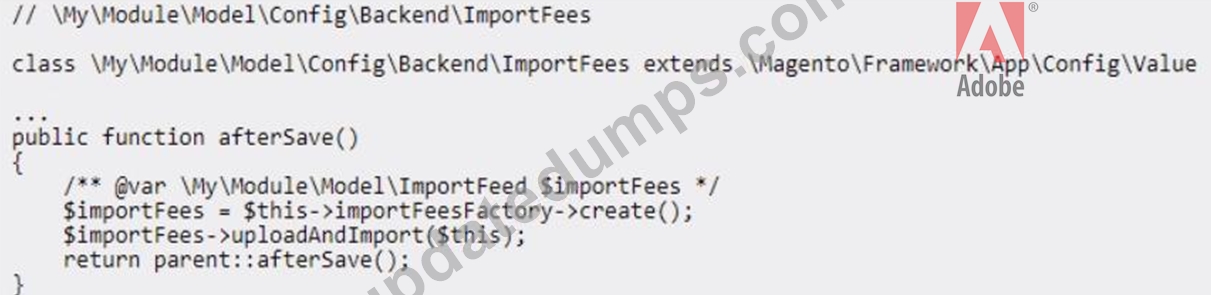
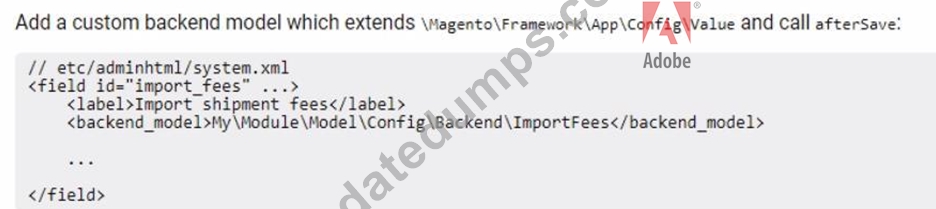
A logistics company with an Adobe Commerce extension sends a list of reviewed shipment fees to all its clients every month in a CSV file. The merchant then uploads this CSV file to a "file upload" field in admin configuration of Adobe Commerce.
What are the two requirements to display the "file upload" field and process the actual CSV import? (Choose two.)
- A.

- B.

- C.
- D.
Answer: B,C
Explanation:
To display a "file upload" field in the Adobe Commerce (Magento) admin configuration and process the uploaded CSV file, two key requirements must be met:
* Backend Model to Handle File Upload Processing (Option B):The backend model (\My\Module\Model\Config\Backend\ImportFees) is required to extend
\Magento\Framework\App\Config\Value and override the afterSave method. This method will contain the logic needed to process the uploaded CSV file after it has been saved. The backend model is the key component that allows you to handle custom processing, like reading the CSV file and executing the required operations.
* Explanation: The backend model is used in Magento to add logic for saving configuration values in a custom way. Here, it's essential because you need to process the CSV file and potentially save additional data in the database or perform other operations.
NEW QUESTION # 39
How can a developer override a core class method in Adobe Commerce?
- A. <typename="Magento\Catalog\Block\Product*> <arguments> q <argument name="rewrtte" xsi:type=" object">Vendor\Module\Block\Product</argument> </arguments> </type>
- B. <typename="Magento\Catalog\Block\Product"> q <rewrite class="Vendor\Module\Block\Producf /> <
/type> - C. <preference for='Magento\Catalog\Block\Product" type="Vendor\Module\Block\Producf />
Answer: C
Explanation:
To override a core class method in Adobe Commerce, the<preference>XML node is used in thedi.xmlfile of a custom module. This node specifies that, for a given interface or class, Magento should use a different class (specified in the "type" attribute) whenever the original class is requested. This allows developers to extend or modify the functionality of core Magento components by substituting their own implementations in a way that is respectful of Magento's extension mechanisms.
NEW QUESTION # 40
How can a developer prioritize a plugin's execution, if possible?
- A. This cannot be achieved as the plugins are always executed by their module's load order in app/etc
/config.php file. - B. The developer can use sortOrder property by specifying a lower value than the target plugin.
- C. The developer can use sortOrder property by specifying a higher value than the target plugin.
Answer: B
Explanation:
A developer can prioritize the execution of a plugin by using thesortOrderproperty within the plugin's declaration in thedi.xmlfile. Specifying a lower value for thesortOrderproperty gives the plugin higher priority, meaning it will be executed before other plugins with a higher sortOrder value. This allows developers to control the order of plugin execution, which can be critical for ensuring the desired outcome when multiple plugins are affecting the same method.
NEW QUESTION # 41
An Adobe Commerce developer added a new API method to search and retrieve a list of Posts for a custom Blog functionality. This is the content of the module's etc/webapi.xml file:
The new code has been deployed to production and the merchant is using https: //merchant. domain. com
/swagger to review the new endpoint, but it is not visible in swagger.
What would be a reason for this?
- A. The greturn annotation is missing in the MyVendor\Blog\Api\PostRepositoryInterf ace class.
- B. Since the new endpoint is not anonymous, the merchant needs to enter a valid integration token in swagger in order to see the new method.
- C. The webapi.xml file should be moved into the etc/webapi_rest/webapi.xml file.
Answer: B
Explanation:
In Adobe Commerce, when defining new API endpoints through the webapi.xml configuration file, the visibility of these endpoints in tools likeSwagger(now OpenAPI) depends on several factors, including authentication settings. According to the provided webapi.xml file:
<?xml version="1.0"?>
<routes
xmlns:xsi="http://www.w3.org/2001/XMLSchema-instance"
xsi:noNamespaceSchemaLocation="urn:magento:module:Magento_Webapi:etc/webapi.xsd">
<route url="/V1/myvendor-blog/post/search" method="GET">
<service class="MyVendor\Blog\Api\PostRepositoryInterface" method="getList"/>
<resources>
<resource ref="MyVendor_Blog::Post_View"/>
</resources>
</route>
</routes>
* Option Asuggests moving the file to etc/webapi_rest/webapi.xml. However, this is incorrect because Adobe Commerce does not require separate XML files for REST and SOAP APIs in this context. The webapi.xml is used for defining routes for both. The structure and location provided in the question are correct for defining REST API routes.
* Option Bis the correct answer. The resource reference MyVendor_Blog::Post_View indicates that this API endpoint is not anonymous; it requires authentication. In Adobe Commerce, if an API endpoint requires authentication, it won't be visible in Swagger (or the OpenAPI UI) unless you provide valid authentication credentials or tokens. This is part of Magento's security model where protected resources require tokens or OAuth to access. For the merchant to see this endpoint in Swagger, they must provide an integration token or OAuth token which has permissions for MyVendor_Blog::Post_View. This is detailed in the Adobe Commerce Developer Documentation under[Web API Authentication](https://x.
com/i/grok?text=Web%20API%20Authentication).
* Option Cmentions the @return annotation missing in the interface class. While proper annotations in PHPDoc are important for IDE autocompletion and documentation generation, they are not directly related to the visibility of an endpoint in Swagger. The visibility in Swagger is determined by the configuration in webapi.xml and the authentication settings, not by PHPDoc annotations. Thus, this option is incorrect in the context of the question.
For further reading on how to manage and configure API endpoints in Adobe Commerce, including authentication, refer to the official Adobe Commerce Developer Guide:
* Web API Configuration
* Web API Authentication
* Swagger Integrationfor testing and documenting APIs.
This explanation covers the necessary aspects of Adobe Commerce API development, focusing on the configuration, authentication requirements, and how these affect the visibility of API endpoints in development tools like Swagger.
NEW QUESTION # 42
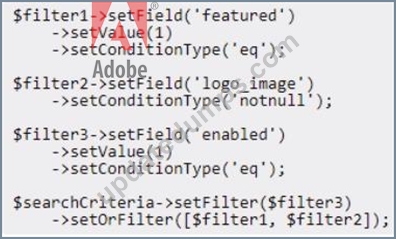
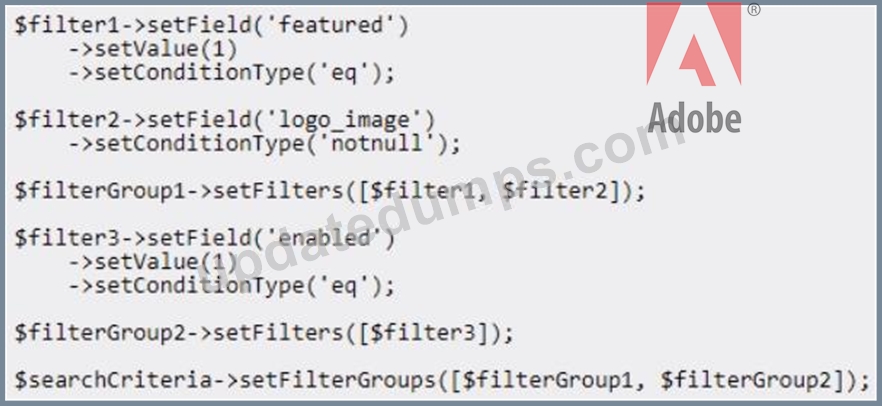
An Adobe Commerce developer is working on a module to manage custom brand entities and wants to replicate the following SQL query using SearchCriteria:
- A.
- B.

- C.
Answer: C
Explanation:
The correct answer isOption A. This approach uses two filter groups to correctly implement the logic from the SQL query using Magento's SearchCriteria API.
* Understanding the Logic:The given SQL query contains two main conditions:
* featured = 1 AND logo_image IS NOT NULL (grouped together with an AND condition)
* enabled = 1
In the Magento SearchCriteria terms, these translate to:
* Filter Group 1: featured = 1 AND logo_image IS NOT NULL
* Filter Group 2: enabled = 1
The two filter groups are then combined using an implicit AND condition.
* Magento's SearchCriteria Structure:The SearchCriteria object is the recommended way in Magento
2 to filter and retrieve collections with complex conditions.
* Filter Groups: Used to group filters together. All filters within a filter group are combined with an AND condition.
* Filters: Define a condition for a single field.
* Explanation of the Code for Option A:
* Filter 1is created for the featured field, set to 1 with an eq condition type.
* Filter 2is created for the logo_image field, with a notnull condition type.
* BothFilter 1andFilter 2are combined intoFilter Group 1, which applies an AND condition between these filters.
* Filter 3is created for the enabled field, set to 1 with an eq condition type.
* Filter Group 2contains onlyFilter 3.
* Finally, both filter groups are set on the SearchCriteria object. By default, the SearchCriteria combines filter groups using an AND condition between them.
* Why Option A is Correct:Option A uses two filter groups that exactly match the desired SQL query logic:
* It correctly combines featured and logo_image in an AND condition.
* It then checks if enabled is 1, which is handled by the second filter group.
NEW QUESTION # 43
An Adobe Commerce developer is asked to create a new payment method for their project. This project has administrators who use the backend to manage customer information and occasionally place orders. When testing the new payment method on the frontend everything worked as expected, however, the payment method is missing in the admin.
What is a possible reason for this?
- A. In the module di.xml, there were no default 3DS verification types configured as a VirtualType.
- B. In the module config.xmi, the boolean value for can_capture was set to false.
- C. In the module config.xmi, the node can_use_internal was not set to true.
Answer: C
Explanation:
For a payment method to be available in the admin panel (backend), the configuration must explicitly allow its internal use. This is controlled by the can_use_internal flag in config.xml.
* Configuration for Admin Use:
* The can_use_internal flag determines if a payment method is available for admin users when placing orders from the backend. By default, this is often set to false for some custom payment methods, meaning they won't appear in the admin.
* Why Option C is Correct:
* Setting can_use_internal to true makes the payment method available for backend order creation, which is why this is the most probable reason it isn't visible in the admin.
* Options A and B do not influence the payment method's availability in the admin; they affect verification types and capture settings, respectively.
NEW QUESTION # 44
How are multiple EAV attributes belonging to the same entity grouped in the database?
- A. Based on all numeric values being stored in one table while text values are stored in the other
- B. Based on the types of values they contain
- C. Based on the sizes of values they contain
Answer: B
Explanation:
Multiple EAV attributes belonging to the same entity are grouped in the database based on their data types, such as datetime, decimal, int, text, or varchar. For example, all attributes with datetime values are stored in one table, while all attributes with text values are stored in another table.
The sizes or numeric/text values of attributes do not determine how they are grouped in the database.
Verified References: [Adobe Commerce Developer Guide - EAV data model]
Magento's EAV (Entity-Attribute-Value) model organizes attributes based on their data types to optimize storage and retrieval. Attributes are grouped into different tables based on whether they store values of types such as integer, varchar (text), decimal, datetime, etc. This organization allows Magento to efficiently manage the diverse data types associated with products, customers, and other entities, ensuring data integrity and optimizing database performance by using appropriate indexing and storage mechanisms for each data type.
NEW QUESTION # 45
......
Exam Sure Pass Adobe Certification with AD0-E724 exam questions: https://pass4sure.updatedumps.com/Adobe/AD0-E724-updated-exam-dumps.html