

Get New 2025 Valid Practice SAP Certified Associate C_THR81_2505 Q&A - Testing Engine
C_THR81_2505 Dumps PDF - 100% Passing Guarantee
SAP C_THR81_2505 Exam Syllabus Topics:
| Topic | Details |
|---|---|
| Topic 1 |
|
| Topic 2 |
|
| Topic 3 |
|
| Topic 4 |
|
NEW QUESTION # 25
Which method of modifying employee data will trigger an event reason derivation?
- A. Deleting a record in history UI
- B. Inserting a new record in history UI
- C. Using Actions menu in People Profile
- D. Using Add New Hire
Answer: C
Explanation:
Event Reason Derivation in SAP SuccessFactors Employee Central is triggered when changes are made to employee data through specific actions. Utilizing the "Actions" menu in the People Profile to update employee information initiates the Event Reason Derivation process. This mechanism automatically determines the appropriate event reason based on the nature of the data change.
In contrast, inserting a new record via the history UI, deleting a record in the history UI, or using the "Add New Hire" function does not trigger Event Reason Derivation. These actions either bypass the derivation process or involve scenarios where event reasons are manually selected.
Therefore, the correct answer is:
B: Using Actions menu in People Profile
This approach ensures that event reasons are accurately derived and recorded in line with the configured business rules in SAP SuccessFactors Employee Central.
NEW QUESTION # 26
What association must you use when configuring a relationship between an MDF-based object and a Foundation Object wrapper?
- A. Valid-When
- B. Join By Column
- C. One-to-one
- D. Composite
Answer: D
NEW QUESTION # 27
How do you enable a cost center in the Succession Data Model to be used as a filter in a permission group?
- A. Go to <custom-filters> then add cost-center
- B. Go to <hris-element="jobInfo"> then add dg-filter="true"
- C. Go to <hris-field id="cost-center"> then add filter="true"
- D. Go to <dg-filters> then add cost-center
Answer: D
Explanation:
To enable a cost center in the Succession Data Model for use as a filter in a permission group, you must:
Navigate to the <dg-filters> section within the Succession Data Model.
Add an entry for the cost-center object within the <dg-filters> section.
This action allows the cost center to be selectable as a filter for Dynamic Groups, which are used to define permission groups in Employee Central.
Correct answer:
A: Go to <dg-filters> then add cost-center
NEW QUESTION # 28
An employee will be changing their nationality information on their own How do you build the IF condition in the business rule so they can do this?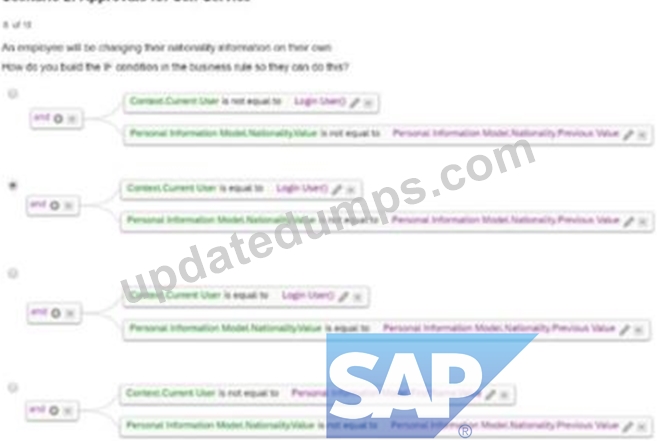
- A. Option D
- B. Option A
- C. Option B
- D. Option C
Answer: C
Explanation:
In order for an employee to change their nationality information on their own, the IF condition must:
Validate that the Context.Current User is equal to Login User (ensures that the logged-in user is making the changes).
Check if the Nationality.Value is not equal to the Nationality.Previous Value (ensures that a change is being made).
Scenario 2: Approvals for Self-Service
NEW QUESTION # 29
What are some of the position management application-specific rule scenarios? Note: There are 3 correct answers to this question.
- A. Update Rule for Mass Change Run
- B. Trigger Rules for Off Cycle Event Batch
- C. Trigger Rules to Calculate Full-Time Equivalent
- D. Create Right to Return for Incumbent
- E. Derive Job Requisition Template in Recruiting Integration
Answer: A,C,D
Explanation:
Application-specific rule scenarios in Position Management include:
A . Create Right to Return for Incumbent:
This rule supports the creation of a right-to-return record for an incumbent when a position-related action occurs, such as a temporary assignment.
B . Update Rule for Mass Change Run:
This rule automates updates during mass position changes, ensuring consistent application of business logic across multiple positions.
C . Trigger Rules to Calculate Full-Time Equivalent:
This rule calculates the FTE value based on position or job information attributes, ensuring accurate reporting and compliance.
These rules enhance the flexibility and functionality of position management processes.
NEW QUESTION # 30
Which steps are required to set up the Auto Delegation feature for a workflow in Employee Central? Note:
There are 2 correct answers to this question.
- A. Enable the field in Succession Data Model.
- B. Enable the auto-delegate permission for users.
- C. Define the delegate relationship in Employee Central.
- D. Enable the field in the Corporate Data Model.
Answer: B,D
Explanation:
To set up the Auto Delegation feature in Employee Central workflows, the following steps are required:
* Enable Auto-Delegate Permission: Users must have the auto-delegate permission enabled, which allows them to define their delegates for workflows.
* Enable Auto-Delegation in the Corporate Data Model: This configuration ensures that the system recognizes and supports the auto-delegation functionality at the framework level.
Correct Answers:
* B: Enable the auto-delegate permission for users.
* D: Enable the field in the Corporate Data Model.
NEW QUESTION # 31
An HR admin/Global Mobility person must create a transfer for an employee. The employee will be moving from Position A in Team A to Position B in Team B. Both managers will have to approve the transfer.
How do you configure a two-step workflow so that the approval goes first to the current manager and second to the future manager?
- A. By selecting in Step 1. Role-Manager - Source
*By selecting in Step 2: Role - Manager - Target - B. By selecting in Step 1: Role - Self-Source
*By selecting in Step 2. Role- Manager - Target - C. By selecting in Step 1. Position Relationship - Parent Parent Position - Source
*By selecting in Step 2: Position Relationship - Parent Position - Target - D. By selecting in Step 1: Role - Manager - Source
*By selecting in Slep 2. Role-Manager Manager - Target
Answer: A
Explanation:
Scenario 2: Approvals for Self-Service
To configure a two-step workflow where the approval first goes to the current manager and then to the future manager, you must set the following in the workflow:
* Step 1: Role - Manager - Source (current manager of the employee).
* Step 2: Role - Manager - Target (future manager of the employee).This setup ensures that the workflow sequentially routes approval to both the current and future managers.
NEW QUESTION # 32
Due to confidentiality reasons, when the HR Business Partner (maintained in Job Relationship) is creating a change in salary for an employee, this action will need to be approved by the manager of the HR Business Partner creating the request.
How do you define this in the workflow when filling in the Approver Type, Approver Role, Context, and Relationship to Approver? Refer to the screenshot to answer the question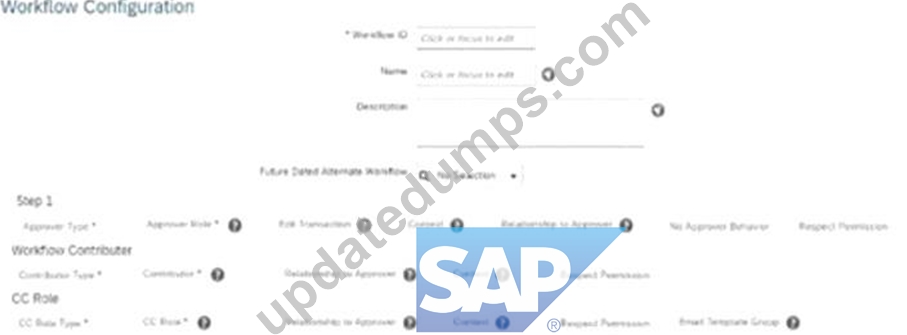
- A. By selecting in Step 1: Role - Employee HR-Source- Initiator
- B. By selecting in Step 1: Role - Self-Source - Initiator
- C. By selecting in Step 1: Role - Employee HR - Source - Employee
- D. By selecting in Step 1: Role - Manager - Source - Initiator
Answer: D
Explanation:
To ensure that the salary change initiated by the HR Business Partner is approved by their manager, you need to configure the workflow with the following details:
* Approver Type: Manager
* Approver Role: Manager
* Context: Initiator (this ensures the approval request is routed to the manager of the person initiating the workflow).
* Relationship to Approver: From the initiator's position, the system derives the relationship to their manager.
Selecting Role: Manager - Source: Initiator in Step 1 aligns with these requirements.
Scenario 2: Approvals for Self-Service
NEW QUESTION # 33
Due to confidentiality reasons, when the HR Business Partner (maintained in Job Relationship) is creating a change in salary for an employee, this action will need to be approved by the manager of the HR Business Partner creating the request.
How do you define this in the workflow when filling in the Approver Type, Approver Role, Context, and Relationship to Approver? Refer to the screenshot to answer the question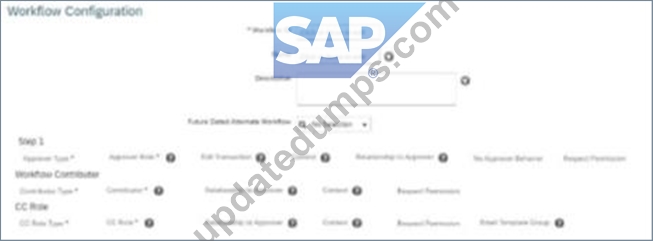
- A. By selecting in Step 1: Role - Employee HR-Source- Initiator
- B. By selecting in Step 1: Role - Self-Source - Initiator
- C. By selecting in Step 1: Role - Employee HR - Source - Employee
- D. By selecting in Step 1: Role - Manager - Source - Initiator
Answer: D
Explanation:
To ensure that the salary change initiated by the HR Business Partner is approved by their manager, you need to configure the workflow with the following details:
Approver Type: Manager
Approver Role: Manager
Context: Initiator (this ensures the approval request is routed to the manager of the person initiating the workflow).
Relationship to Approver: From the initiator's position, the system derives the relationship to their manager.
Selecting Role: Manager - Source: Initiator in Step 1 aligns with these requirements.
Scenario 2: Approvals for Self-Service
NEW QUESTION # 34
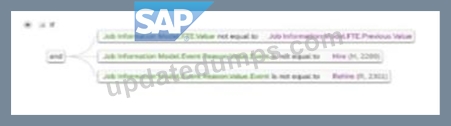
Which condition must be used for the jobinfo_FTE_Comp rule?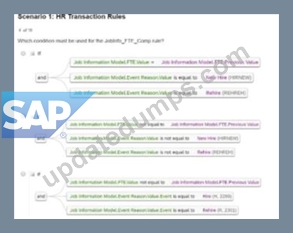
- A. Option A
- B. Option C
- C. Option B
- D. Option D
Answer: D
Explanation:
For the Jobinfo_FTE_Comp rule, the correct condition to use is Option D. This ensures that the system evaluates changes in FTE values and event reasons to calculate and adjust compensation data accordingly. The precise conditions are necessary to maintain consistency in how the rule is applied across various HR scenarios.
Scenario 1: HR Transaction Rules
NEW QUESTION # 35
Fields in the termination screen are configured in which hris-element?
- A. Job Information
- B. Employment Information
- C. Compensation Information
- D. Personal Information
Answer: B
Explanation:
Fields displayed on the termination screen are configured in the Employment Information HRIS element. This element contains employment-specific details, such as hire dates, termination dates, and reasons for termination.
Other HRIS elements like Personal Information, Compensation Information, and Job Information do not manage termination-specific configurations
NEW QUESTION # 36
How is the event reason derived when a business rule is enabled for import?
- A. The onSave ERD rule overrides the event reason value indicated in the import file.
- B. The event reason is derived using the catch-all rule.
- C. The event reason must be selected manually.
- D. The event reason indicated in the import overrides the onSave ERD rule.
Answer: D
Explanation:
In SAP SuccessFactors Employee Central, when a business rule is enabled for import, the event reason specified in the import file takes precedence. This means that the event reason indicated in the import file will override any onSave Event Reason Derivation (ERD) rules configured in the system.
Options A, B, and D are not accurate in this context:
A . The event reason is derived using the catch-all rule.
This is incorrect because the event reason in the import file overrides other rules.
B . The event reason must be selected manually.
This is not applicable during the import process, as the event reason is provided in the import file.
D . The onSave ERD rule overrides the event reason value indicated in the import file.
This is incorrect; the import file's event reason takes precedence over onSave ERD rules.
NEW QUESTION # 37
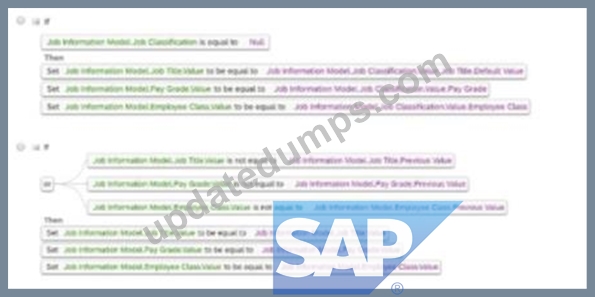
Which rule supports the Default_JobClass requirement?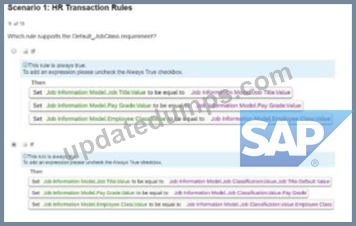
- A. Option D
- B. Option A
- C. Option B
- D. Option C
Answer: C
Explanation:
The rule in Option B supports the Default_JobClass requirement by setting default values for fields such as Job Title, Pay Grade, and Employee Class when the Job Classification field is NULL. This ensures that appropriate default data is applied to job information records when certain fields are not explicitly filled.
Scenario 1: HR Transaction Rules
NEW QUESTION # 38
The HR admin has to change the salary of an employee, which will trigger a workflow for the employee's manager. The employee's manager should be able to edit the transaction if the proposed amount is NOT correct.
Where in the workflow do you need to define this?
Refer to the screenshot to answer the question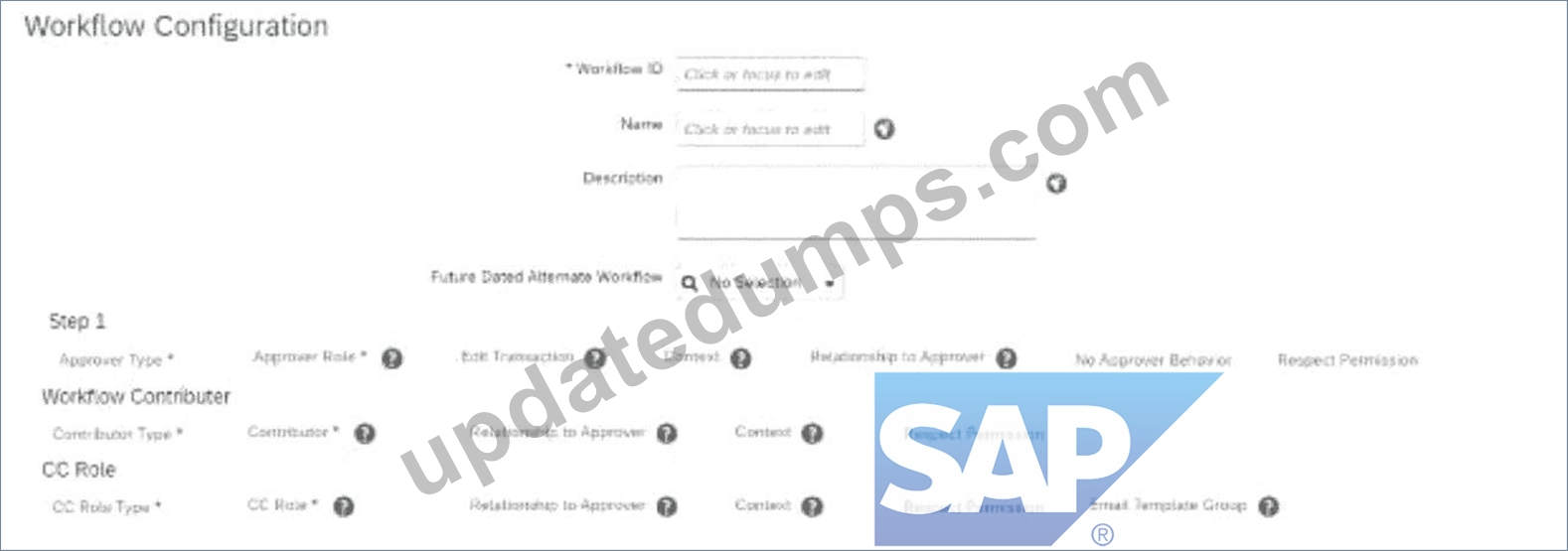
- A. Respect Permission
- B. Context
- C. No Approver Behavior
- D. Edit Transaction
Answer: D
Explanation:
To allow the employee's manager to edit a transaction in a workflow if the proposed salary change is incorrect, you must configure the "Edit Transaction" setting in the workflow.
* The "Edit Transaction" option is part of the workflow configuration in Step 1 (as shown in the screenshot).
* When enabled, it allows the approver (in this case, the manager) to make adjustments to the transaction before approving it.
Scenario 2: Approvals for Self-Service
NEW QUESTION # 39
Which of the following are examples of standard one-to-one associations? Note: There are 2 correct answers to this question.
- A. Location to Legal Entity
- B. Pay Range to Legal Entity
- C. Location to Geozone
- D. Department to Division
Answer: B,C
Explanation:
Standard one-to-one associations link objects in a parent-child relationship, where each instance of the parent object is associated with one instance of the child object. Examples include:
Location to Geozone: A location belongs to one specific geozone.
Pay Range to Legal Entity: A pay range is tied to a single legal entity.
Location to Legal Entity and Department to Division are examples of one-to-many associations.
NEW QUESTION # 40
You need to create a one-to-many association from Location to Legal Entity. You also need to configure filtering of the Location field based on the Company field in the Job Information block.
What do you need to add to the data models? Note: There are 2 correct answers to this question.
- A. <association> as part of <hris-element id="location">
- B. <association> as part of <hris-element id="jobInfo">
- C. <field-criteria> as part of <hris-field="location">
- D. <field-criteria> as part of <hris-field="company">
Answer: A,C
Explanation:
To establish a one-to-many association from Location to Legal Entity and enable filtering of the Location field based on the Company field in the Job Information block, the following configurations are necessary:
Define the Association in the Location Object:
In the location object definition, add an <association> element to link it to the legalEntity object. This association should be defined within the <hris-element id="location"> section.
Configure Field Criteria for the Location Field:
Within the Job Information (jobInfo) element, add a <field-criteria> element as part of the <hris-field id="location">. This configuration ensures that the Location field is filtered based on the selected Company (Legal Entity) in the Job Information block.
Therefore, the correct answers are:
B: <field-criteria> as part of <hris-field id="location">
D: <association> as part of <hris-element id="location">
These configurations align with the standard practices for setting up associations and field criteria in SAP SuccessFactors Employee Central.
NEW QUESTION # 41
Which permission controls a user's access to the Edit button in the history of Job Information?
- A. Edit Link > Edit/Insert
- B. Job Information Actions > View History
- C. Job Information Actions > Correct
- D. Job Information Actions > Edit/Insert
Answer: C
Explanation:
Job Information Actions > Correct permission controls the Edit button in the Job Information history.
This permission allows users to correct existing records without creating a new effective-dated record. It ensures that only authorized users can make retroactive changes to historical data.
Other permissions, such as Edit Link > Edit/Insert, Job Information Actions > Edit/Insert, or Job Information Actions > View History, do not directly control access to the Edit button in the history section.
NEW QUESTION # 42
What field of the country-specific Corporate Address element is required in the Corporate Data Model?
- A. Country
- B. City
- C. Address1
- D. Location
Answer: A
Explanation:
In the Corporate Data Model, the country-specific Corporate Address element requires the field Country to be specified. This ensures that address configurations are appropriately associated with a country.
NEW QUESTION # 43
What is generic object foTranslation used for in SAP SuccessFactors Employee Central?
- A. To translate MDF FO field labels
- B. To translate any generic object field labels in the instance
- C. To translate XML FO field labels
- D. To translate XML and MDF FO field labels
Answer: A
NEW QUESTION # 44
When the manager updates the location of an employee, the HR admin must be the approver Note that the HR admin, manager, and HR Business Partner have access to change the location.
How do you create the IF condition for the workflow derivation rule lo meet the above requirements?
- A. Option D
- B. Option C
- C. Option A
- D. Option B
Answer: C
Explanation:
To meet the requirement where the HR admin must approve the manager's updates to an employee's location, the workflow derivation rule must include the following IF condition:
* Option A: Ensures that the condition checks whether the user belongs to the permission group for HR Admins, and the Event Reason value matches "Location Change".This configuration aligns the workflow rule with the scenario requirements, where HR admins are explicitly designated as approvers Scenario 2: Approvals for Self-Service
NEW QUESTION # 45
Based on the screenshot below, can you identify any errors on the definition of the business rule to Default Position Attributes? Note: There are 2 correct answers to this question.
- A. The FTE field should be derived from the business rule to Calculate FTE based on Standard Hours.
- B. The Company field should NOT be included in the business rule.
- C. The Parent Position field should NOT be included in the business rule.
- D. The workflow configuration should NOT be included in the business rule.
Answer: A,C
Explanation:
* C. The Parent Position field should NOT be included in the business rule:
* The Parent Position field is typically derived automatically based on position hierarchy and does not require explicit inclusion in a business rule for defaulting position attributes.
* D. The FTE field should be derived from the business rule to Calculate FTE based on Standard Hours:
* The FTE (Full-Time Equivalent) value should be calculated using a dedicated rule that accounts for standard hours, rather than being directly included in a defaulting rule.
Including these fields inappropriately can lead to data inconsistencies or rule execution issues.
NEW QUESTION # 46
......
C_THR81_2505 Braindumps Real Exam Updated on Oct 13, 2025 with 86 Questions: https://pass4sure.updatedumps.com/SAP/C_THR81_2505-updated-exam-dumps.html