

2026 Current NetSec-Analyst dumps Preparation through Our Practice Test
100% Reliable Microsoft NetSec-Analyst Exam Dumps Test Pdf Exam Material
Palo Alto Networks NetSec-Analyst Exam Syllabus Topics:
| Topic | Details |
|---|---|
| Topic 1 |
|
| Topic 2 |
|
| Topic 3 |
|
| Topic 4 |
|
NEW QUESTION # 23
Place the steps in the correct packet-processing order of operations.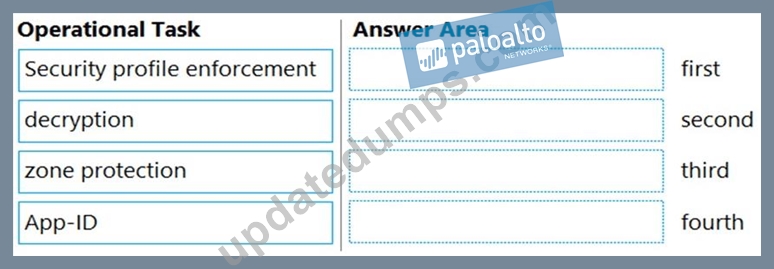
Answer:
Explanation: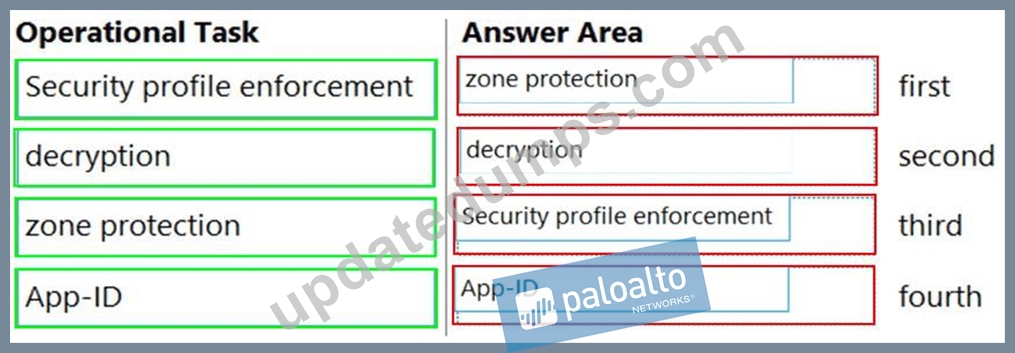
NEW QUESTION # 24
Which tool should an analyst use to view a real-time, graphical representation of the top applications, users, and threats across the network to identify immediate anomalies?
- A. ACC (Application Command Center)
- B. Log Viewer
- C. Policy Optimizer
- D. Config Audit
Answer: A
Explanation:
Comprehensive and Detailed 150 to 250 words of Explanation From Palo Alto Networks Network Security Analyst Knowledge:
The Application Command Center (ACC) is the primary visual monitoring tool for a Palo Alto Networks analyst. Unlike the Log Viewer, which provides a text-based, chronological list of events, the ACC provides an aggregated, graphical dashboard that highlights trends and anomalies.
The ACC uses "widgets" to display data such as the "Top Applications," "Top Threats," and "Top Users by Bandwidth". For an analyst, the ACC is the starting point for "threat hunting" and performance monitoring.
For example, if an analyst sees a sudden spike in "Unknown-UDP" traffic in the ACC, they can click on that specific widget to "drill down" and see which users and source IPs are responsible for that traffic. This allows the analyst to quickly identify potential botnet activity or misconfigured applications that would be much harder to spot in raw log data.
NEW QUESTION # 25
An organization is migrating its internal certificate authority (CA) infrastructure. They have existing SSL Inbound Inspection policies on a Palo Alto Networks firewall that utilize certificates and private keys from the old CA. The new CA will issue new certificates for internal servers. What is the most operationally efficient and secure way to transition the decryption policies to use the new certificates without service interruption, assuming a phased migration of servers?
- A. Create entirely new Decryption Policies and Decryption Profiles for each server using the new certificates, and then disable the old policies/profiles once all servers are migrated.
- B. Export the new server certificates and private keys from the new CA, import them directly into the existing decryption profiles, overwriting the old certificates.
- C. Configure the Palo Alto Networks firewall to act as a subordinate CA to the new internal CA, then generate new decryption certificates directly on the firewall for all relevant servers.
- D. Import the new server certificates and private keys into separate 'Certificate Profiles' on the firewall. Then, modify the existing 'Decryption Profiles' to allow selecting multiple 'Certificate Profiles' or dynamically choosing the correct one based on the server certificate presented.
- E. Import the new server certificates and private keys into new 'Server Certificate' objects. Create new 'Decryption Profiles' that reference these new certificates. Modify existing 'Decryption Policies' to include duplicate rules one for the old certificate profile and one for the new, using source/destination IP addresses to differentiate phased servers. Once all servers migrate, remove the old rules and profiles.
Answer: E
Explanation:
This scenario requires a phased approach to avoid service disruption. Option E is the most operationally efficient and secure method. You cannot simply overwrite certificates (Option A) without causing an outage for servers still using the old certs. Creating entirely new policies and profiles (Option B) is less efficient and harder to manage during a phased rollout. Palo Alto Networks firewalls do not dynamically choose certificate profiles based on presented server certificates within a single decryption profile (Option C). Option D is more about the firewall's own CA capabilities, not for managing existing server certificates for inbound inspection during migration. The correct approach (Option E) involves: 1) Importing the new certificates as distinct 'Server Certificate' objects. 2) Creating new 'Decryption Profiles' that reference these new certificates. 3) Modifying the existing decryption policies. Instead of duplicating the entire policy, you can modify the rule that applies to these servers. You'd typically use source or destination IP addresses (or even a specific custom URL category if the servers have distinct FQDNs) to target the servers as they migrate. For instance, if Server A has migrated to the new cert, its traffic hits a rule referencing the new profile; if Server B is still on the old cert, its traffic hits a rule referencing the old profile. Once all servers in a group have migrated, the rule for the old certificate profile can be removed. This maintains continuous decryption throughout the transition.
NEW QUESTION # 26
The Palo Alto Networks NGFW was configured with a single virtual router named VR-1 What changes are required on VR-1 to route traffic between two interfaces on the NGFW?
- A. Enable the redistribution profile to redistribute connected routes
- B. Add zones attached to interfaces to the virtual router
- C. Add a static routes to route between the two interfaces
- D. Add interfaces to the virtual router
Answer: C
NEW QUESTION # 27
A financial institution is deploying IoT devices for environmental monitoring in its data centers. These devices use HTTPS for communication with a cloud-based management platform. Due to compliance requirements, all data leaving the data center must be inspected for sensitive information (e.g., financial data leakage, PII). Additionally, the devices must be authenticated using client certificates. Describe the comprehensive Palo Alto Networks IoT security profile configuration that ensures both deep content inspection and device authentication for these IoT devices.
- A. Implement 'URL Filtering' to allow only the cloud management platform's domain. Create a 'Data Filtering' profile to inspect for sensitive data. Configure a 'Security Policy' allowing HTTPS to the cloud platform, applying both URL Filtering and Data Filtering. Rely on pre-shared keys for device authentication.
- B. Deploy a 'Web Proxy' in front of the NGFW for HTTPS inspection. Configure the NGFW to use 'User-ID' for device authentication and integrate it with an external AAA server. Use 'File Blocking' to prevent data leakage.
- C. Create an 'IoT Security Profile' with 'Device-ID' enabled. Configure a 'Security Policy' rule from the IoT zone to the Internet, specifying 'Application: ssl', 'Service: application-default', and enable 'SSL Decryption' with a forward trust certificate. Additionally, configure 'Client Certificate Authentication' within the 'Authentication Profile' linked to the security rule.
- D. Apply a 'Threat Prevention' profile to block all suspicious activity. Create a 'Tunnel Inspection' profile for all IoT traffic. Configure a 'Security Policy' with 'Source: IoT Zone', 'Destination: Cloud IP', 'Application: any', and 'Action: Allow'.
- E. Configure a 'NAT Policy' to translate IoT device IPs. Create a 'Custom URL Category' for the cloud platform. Enable 'DDoS Protection' for the IoT zone. Device authentication will be handled at the cloud platform level.
Answer: C
Explanation:
Option A is the most comprehensive and correct approach for both deep content inspection and device authentication using Palo Alto Networks NGFWs.
1. 'SSL Decryption' with a forward trust certificate is essential for inspecting HTTPS traffic payload for sensitive data.
2. 'Client Certificate Authentication' within an 'Authentication Profile' linked to the security rule allows the firewall to validate the IoT device's certificate presented during the SSL handshake, fulfilling the device authentication requirement.
3. 'Device-ID' is crucial for classifying and grouping these IoT devices for policy enforcement. Option B lacks client certificate authentication and deep content inspection. Option C is too vague and misuses 'Tunnel Inspection'. Option D misses the core requirements. Option E introduces a web proxy, which might be an alternative but isn't the direct NGFW capability for client certificate authentication and 'User-ID' is typically for human users, not direct device authentication via certificates at the network layer.
NEW QUESTION # 28
A critical application experiences intermittent connectivity issues. The Network Security Analyst suspects a misconfigured security policy on the Palo Alto Networks firewall. The analyst navigates to the Log Viewer and performs a filter for 'deny' actions on the application's destination IP and port, observing several such logs. What are the NEXT logical steps to effectively remediate this issue using the Incidents and Alerts page and Log Viewer data?
- A. Correlate the 'deny' logs with any related alerts on the Incidents and Alerts page. Then, analyze the 'Rule Name' field in the Log Viewer for the specific deny logs to identify the blocking policy. Based on this, either modify the existing policy or create a new, more specific policy rule placed above the blocking rule.
- B. Disable all Security Profiles associated with the policies affecting the application to see if connectivity is restored, then re-enable them one by one to isolate the issue.
- C. Run a 'Packet Capture' on the firewall for the application's traffic to identify the exact point of failure, then open a support ticket with Palo Alto Networks.
- D. Review the URL Filtering logs for the application's traffic, as URL filtering is often the cause of application connectivity issues.
- E. Immediately create a new security policy rule at the top of the rulebase to allow all traffic to the application's IP and port, then monitor for resolution.
Answer: A
Explanation:
When 'deny' logs are observed, the most effective next step is to identify which security policy is responsible for the denial. The 'Rule Name' field in the Log Viewer is crucial for this. Once the blocking policy is identified, the analyst can determine if the policy needs modification (e.g., adding the specific application port/service) or if a new, more permissive but still secure, policy needs to be created and placed with a lower rule ID (higher in the rulebase) to be evaluated before the denying rule. Correlating with Incidents and Alerts can provide broader context, but directly identifying the denying rule is paramount. Option A is too broad and could introduce security risks. Option C is disruptive and not the primary diagnostic step. Option D is a later step if policy analysis fails. Option E is less likely for general application connectivity unless HTTP/HTTPS is involved and URL categories are explicitly denied.
NEW QUESTION # 29
A company wants to ensure that all internal users are prevented from uploading sensitive documents to a specific personal cloud storage site. Which Security profile is specifically designed to inspect the content of file transfers for specific data patterns?
- A. Data Filtering Profile
- B. Vulnerability Protection Profile
- C. WildFire Analysis Profile
- D. File Blocking Profile
Answer: A
Explanation:
Comprehensive and Detailed 150 to 250 words of Explanation From Palo Alto Networks Network Security Analyst Knowledge:
While a File Blocking Profile (Option A) can block files based on their type (e.g., preventing any .docx upload), it does not look at the information within the file. The Data Filtering Profile is the tool designed for Data Loss Prevention (DLP).
An analyst uses Data Filtering to scan file uploads and downloads for specific sensitive patterns, such as credit card numbers, Social Security numbers, or custom regex patterns (like internal project IDs). By attaching this profile to a security rule that allows access to the cloud storage application, the firewall can permit the use of the app while specifically blocking any session that contains unauthorized data. This provides a granular layer of security that protects intellectual property and ensures regulatory compliance without completely disabling the business applications users need to perform their jobs.
NEW QUESTION # 30
What Policy Optimizer policy view differ from the Security policy do?
- A. It indicates rules with App-ID that are not configured as port-based.
- B. It indicates that a broader rule matching the criteria is configured above a more specific rule.
- C. It shows rules that are missing Security profile configurations.
- D. It shows rules with the same Source Zones and Destination Zones.
Answer: A
Explanation:
Policy Optimizer policy view differs from the Security policy view in several ways. One of them is that it indicates rules with App-ID that are not configured as port-based. These are rules that have the application set to "any" instead of a specific application or group of applications. These rules are overly permissive and can introduce security gaps, as they allow any application traffic on the specified ports. Policy Optimizer helps you convert these rules to application-based rules that follow the principle of least privilege access12. You can use Policy Optimizer to discover and convert port-based rules to application-based rules, and also to remove unused applications, eliminate unused rules, and discover new applications that match your policy criteria3. References:
* Policy Optimizer Best Practices - Palo Alto Networks
* Manage: Policy Optimizer - Palo Alto Networks | TechDocs
* Why use Security Policy Optimizer and what are the benefits?
NEW QUESTION # 31
All users from the internal zone must be allowed only HTTP access to a server in the DMZ zone.
Complete the empty field in the Security policy using an application object to permit only this type of access.
Source Zone: Internal -
Destination Zone: DMZ Zone -
Application: __________
Service: application-default -
Action: allow
- A. Application = "any"
- B. Application = "web-browsing"
- C. Application = "http"
- D. Application = "ssl"
Answer: B
NEW QUESTION # 32
Which statement is true regarding a Prevention Posture Assessment?
- A. It provides a percentage of adoption for each assessment area
- B. It provides a set of questionnaires that help uncover security risk prevention gaps across all areas of network and security architecture
- C. It performs over 200 security checks on Panorama/firewall for the assessment
- D. The Security Policy Adoption Heatmap component filters the information by device groups, serial numbers, zones, areas of architecture, and other categories
Answer: B
NEW QUESTION # 33
What are two valid pattern types in a Data Filtering profile? (Choose two.)
- A. Custom Dictionary
- B. File Properties
- C. Proximity Pattern
- D. Regular Expression
Answer: B,D
Explanation:
Comprehensive and Detailed 150 to 250 words of Explanation From Palo Alto Networks Network Security Analyst Knowledge:
In the Palo Alto Networks ecosystem, specifically when utilizing Strata Cloud Manager (SCM) and Enterprise Data Loss Prevention (DLP), Data Filtering profiles are used to identify and protect sensitive information. When an analyst creates a custom data pattern to be used within these profiles, the system allows for two primary methods of identification: Regular Expressions (Regex) and File Properties.
Regular Expressions (D) allow the analyst to define a specific string or numerical pattern, such as a custom employee ID format or a proprietary project code. This is the most flexible and common way to catch sensitive text data within a file or data stream.
File Properties (C) allow the analyst to create patterns based on the metadata or attributes of a file rather than its contents. This includes identifying files based on the "Author," "Title," "Company," or even custom tags embedded in document properties (e.g., Microsoft Word or PDF metadata). By combining these two pattern types, a Network Security Analyst can create a highly granular detection engine. For instance, a policy could block any file where the "Company" property is set to a competitor or any file containing text that matches a specific Regex-defined sensitive data format.
While "Predefined" patterns (like Credit Card numbers) are also a core component, they are not listed as an option here. "Proximity Patterns" are a feature used to reduce false positives by ensuring two patterns appear near each other, but the fundamental "pattern types" for custom definitions are Regex and File Properties.
NEW QUESTION # 34
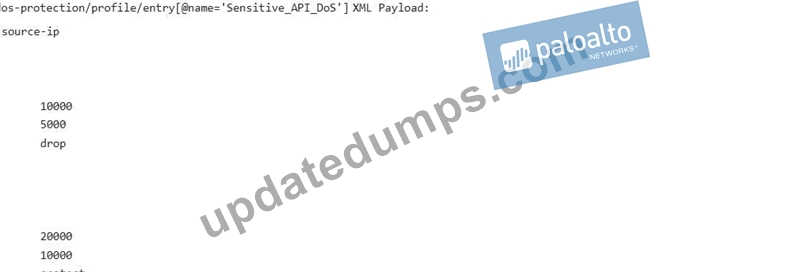
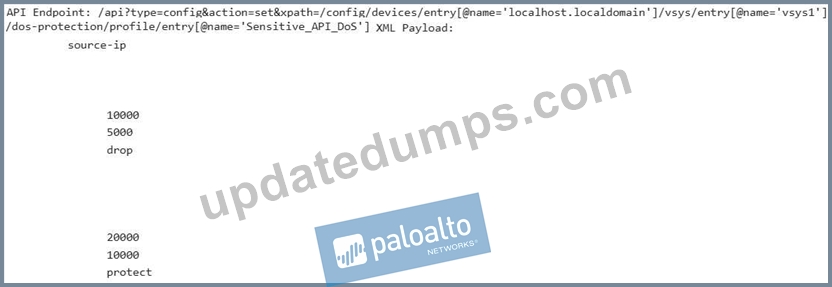
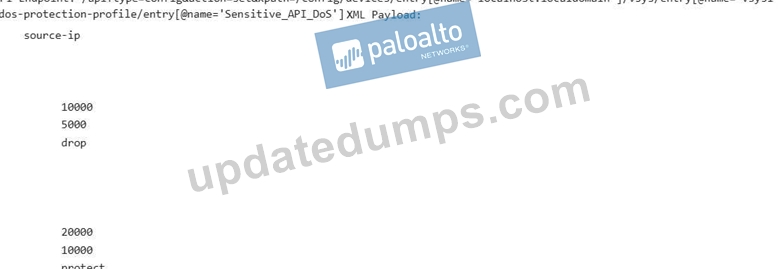
You are tasked with automating the deployment and management of DoS protection profiles on multiple Palo Alto Networks firewalls using the PAN-OS API. A new DoS protection profile, 'Sensitive_APl DOS', needs to be created that applies 'Packet Based Attack Protection' for UDP floods (activation-rate 10000, alarm-rate 5000, action drop) and 'Session Based Attack Protection' for Max Concurrent Sessions (activation-rate 20000, alarm-rate 10000, action protect), with 'group-by source-ip'. Which of the following API calls, using an appropriate XML payload, would correctly create this profile? (Assume correct authentication and URL for the API endpoint).
- A.
- B. None of the above correctly constructs the DoS Protection Profile for the PAN-OS API.
- C.
- D.

- E.
Answer: A
Explanation:
To correctly create a DoS Protection Profile via the PAN-OS API, the XML structure must accurately reflect the firewall's configuration hierarchy. 1 . XPath: The correct XPath for a DoS Protection Profile is
which is typically required. 2. XML Payload Structure: A DoS Protection Profile directly contains the 'group-by' and 'thresholds' elements. The 'thresholds' element then contains 'packet-based-attack-protection' and 'session-based-attack-protection'. Option A places 'packet-based...' and 'session-based...' directly under the profile entry, missing the and elements at the correct level. Option B has an incorrect XPath and wraps the entire definition under a which is not how a profile is defined directly. Option C correctly places and directly under the profile entry, and then structures the flood protections correctly under . This matches the typical PAN-OS configuration structure for a DoS protection profile. Option D's payload structure is also incorrect as it places and directly under the profile entry, without the wrapper. Therefore, Option C provides the most accurate XML payload and XPath for creating the specified DoS protection profile.
NEW QUESTION # 35
Consider a Palo Alto Networks firewall with a complex routing setup. Traffic from the 'Servers' zone destined for a specific SaaS application (app-id: 'saas-crm', destination IP range: 172.16.0.0/20) must be routed through a dedicated VPN tunnel interface (tunnel. 1) and then to a cloud-based SD-WAN appliance with next-hop 10.0.0.1. However, if the SD-WAN appliance becomes unreachable, this traffic must be blocked. Under no circumstances should it fall back to the default route (primary internet uplink). All other traffic from the 'Servers' zone to 'Untrust' should use the default route. Which PBF configuration best achieves this, and what is the critical element for blocking failover?
- A. Use a Static Route for 172.16.0.0/20 via tunnel.1' with a higher metric than the default route, and rely on firewall session timeout to drop traffic if the next hop is unreachable.
- B. Create a PBF rule:

- C. O Configure a PBF rule with 'Action: Forward', 'Egress Interface: tunnel. 1', 'Next Hop: 10.0.0.1', and set 'Fall back to: Discard' for the specific SaaS traffic. This rule must be prioritized above other 'Servers' zone PBF rules.
- D. Create a PBF rule:

- E. Create two PBF rules: one for forwarding the SaaS traffic and a second, lower-priority PBF rule for the same traffic with 'Action: Discard' if the first rule's next-hop fails, monitored by BFD.
Answer: C
Explanation:
Option C is the precise solution. The Palo Alto Networks PBF 'Action' includes 'Discard', which means if the specified forwarding path (egress interface + next-hop) becomes unreachable or fails its monitoring checks, the traffic matching that PBF rule will be explicitly discarded instead of falling back to a default route or being handled by a subsequent PBF rule. The 'Fall back to: Discard' is specifically designed for scenarios where traffic must be dropped if its preferred path is unavailable. Option A suggests 'Fall back to: No', which means it will fall back to the next eligible PBF rule or the default virtual router route, which is not desired here. Option B is incorrect as 'No-PBF' means the traffic will follow regular routing, and a security policy rule wouldn't block based on PBF path failure. Option D relies on routing metrics, which doesn't provide the granular application-aware 'block on failure' behavior of PBF. Option E incorrectly suggests a second PBF rule for discarding on failure; the 'Discard' action is a direct setting within a single PBF rule for fallback.
NEW QUESTION # 36
Why does a company need an Antivirus profile?
- A. To protect against viruses, worms, and trojans
- B. To prevent known exploits
- C. To prevent command-and-control traffic
- D. To prevent access to malicious web content
Answer: A
NEW QUESTION # 37
An organization relies heavily on cloud applications. Due to compliance requirements, they must log all successful and unsuccessful login attempts to sensitive cloud applications, including the user, application, and source IP. Additionally, they need to generate real- time alerts for any failed login attempts exceeding a threshold (e.g., 3 failed attempts within 5 minutes) from a single source IP to a sensitive application. How would you configure Palo Alto Networks firewall logs and profiles to meet these requirements?
- A. Set the security policy 'Action' to 'Deny' for sensitive applications, which will automatically log failed attempts. Use an 'External Dynamic List' for sensitive application URLs and link it to a 'URL Filtering' profile that generates alerts on block actions.
- B. Enable 'Log at Session End' on the security policy for the sensitive applications. Configure an 'Alert Log' setting in the 'Monitor' tab for 'authentication-failed' messages with a threshold.
- C. Enable 'Log at Session Start' for the security policy. Create a custom 'Log Forwarding Profile' to send all traffic logs to an external SIEM. Configure the SIEM to generate alerts based on failed authentication events and thresholds.
- D. Enable 'SSL Decryption' for all cloud application traffic. Configure a 'Vulnerability Protection' profile with a custom signature to detect failed login attempts and set the action to 'alert'.
- E. For the security policy governing sensitive cloud applications, set 'Log at Session End'. Create a 'Log Forwarding Profile' to forward 'Authentication' logs to the Panorama management server. On Panorama, configure a 'Managed Log Forwarding Profile' with an 'Email' alert for 'authentication-failed' events, and enable 'Alerting on Repeated Failures' with the specified threshold and timeframe.
Answer: E
Explanation:
Option C is the most comprehensive and correct approach. 1. Logging All Login Attempts: 'Log at Session End' on the security policy ensures that the full session details, including application and user (if User-ID is enabled, which is crucial for this scenario), are logged. Successful and unsuccessful authentication attempts are part of these logs, especially if App-ID properly identifies the login process. 2. Real-time Alerts for Failed Attempts with Threshold: The key here is using the 'Authentication' logs, which are distinct from generic 'Traffic' logs and specifically contain authentication events. Forwarding these to Panorama (or a Syslog server, but Panorama provides built-in alerting). Panorama's 'Managed Log Forwarding Profile' allows for granular alerting on specific log types ('Authentication' logs in this case) and, critically, offers 'Alerting on Repeated Failures' with configurable thresholds for time and count from a source. This directly addresses the requirement for failed login attempt alerting with a threshold from a single source IP. Other options are less precise: A lacks the specific 'Authentication' log forwarding and thresholding mechanism. B offloads everything to the SIEM, which is valid but doesn't leverage the firewall's built-in advanced alerting. D (Vulnerability Protection) is for exploits, not authentication logging/alerting. E (Deny action and URL Filtering) is incorrect as it focuses on blocking and URL categorization rather than granular authentication logging and repeated failure alerting.
NEW QUESTION # 38
......
Free NetSec-Analyst Dumps are Available for Instant Access: https://pass4sure.updatedumps.com/Palo-Alto-Networks/NetSec-Analyst-updated-exam-dumps.html